


Key takeaways
- PPF marketing works differently from regular detailing because buyers need education before they are ready to book.
- A dedicated PPF service page and Google Business Profile are the two strongest foundations for organic PPF leads.
- Before-and-after content, real reviews, and transparent pricing help build trust and filter better leads.
- Meta Ads work best when they target new car, EV, luxury, and performance vehicle owners.
- Dealership partnerships can create high-value referral leads when the offer is simple and easy to explain.
- The strongest PPF marketing system combines SEO, GBP, content, ads, reviews, and follow-up.
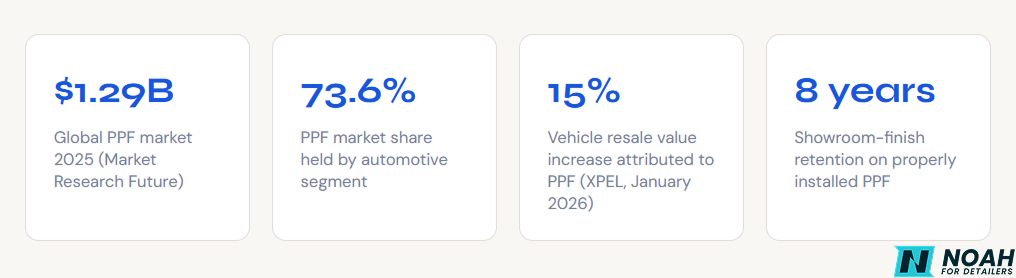
PPF marketing for auto detailers is one of the biggest untapped opportunities in the United States right now. The global paint protection film market reached $1.29 billion in 2025, with North American demand continuing to grow steadily, yet most installers still rely on referrals, word of mouth, and occasional social media posts to generate leads.
That gap exists for a simple reason. Most car owners do not even know what PPF is until they start searching for ways to protect their vehicle’s paint. They are not typing “PPF installer near me.” Instead, they search for terms like “clear bra for cars,” “car paint protection film,” or “how to prevent rock chips.”
This changes how PPF marketing works.
Unlike ceramic coating or general detailing services, PPF requires a system that educates buyers before selling, builds trust through proof and transparency, and captures demand at multiple stages of the research process.
In the United States, where demand for paint protection film is growing due to luxury vehicles, new car purchases, and EV adoption, auto detailers who build a proper marketing system now have a clear advantage.
In this guide, you will learn how to generate consistent paint protection film leads using SEO, content, paid ads, and partnerships. Whether you run a full-service detailing studio or specialize in PPF installation, these strategies are designed to help you dominate your local market.
If your PPF page is not converting visitors into enquiries, read our guide on how to improve a PPF website before spending more on ads.
Who This Guide Is For:
This guide is for auto detailers, PPF installers, ceramic coating studios, tint shops, and automotive appearance businesses that want to generate more paint protection film leads.
It is especially useful if you already offer PPF but still rely mostly on referrals, word of mouth, Instagram posts, or occasional ads to get jobs.
What Makes PPF Marketing Different From Other Detailing Services?
PPF is not sold the same way as a basic detail or maintenance wash. Many buyers do not fully understand what paint protection film is, what it protects, how much it costs, or why it is worth the investment.
Ceramic coating buyers often already understand the service before they search. PPF buyers usually need more education. They may start by searching for problems like rock chips, paint damage, road debris, or how to protect a new vehicle.
That creates a longer buying journey.
Before someone books a PPF installation, they usually need to understand:
- What PPF does
- Which areas of the vehicle should be protected
- How PPF compares to ceramic coating
- What different packages cost
- Whether the installer has real experience
- What previous customers say
This is why a strong PPF marketing system needs education, proof, pricing clarity, local visibility, and follow-up.
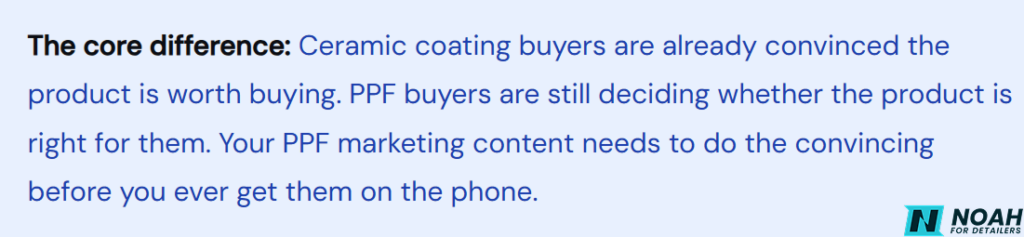
The eight strategies below address this reality directly. Each one is designed to intercept buyers at a different stage of their research journey, from first awareness through to booked installation.
The PPF Market Opportunity in the United States
Before building your PPF marketing system, it helps to understand the scale of the opportunity. The PPF market growth numbers from Market Research Future project the global market reaching $2.14 billion by 2035. In the United States specifically, the IMARC Group reports the US PPF market was valued at $95.3 million in 2025 and is projected to reach $164.2 million by 2034.
What makes this particularly relevant for your PPF marketing is the EV angle. Electric vehicles, with their premium paint finishes and higher average ownership costs, are driving a significant segment of new PPF demand. Tesla, Rivian, and other EV manufacturers are actively promoting PPF through their dealership networks.
XPEL opened a new manufacturing facility in Mexico in 2025 specifically to serve the growing North American market. This is not a niche accessory market. It is a mainstream automotive protection category, and US installers who build their PPF marketing infrastructure now will own their local markets before the larger automotive chains get organized.
| PPF Package Tier | Coverage Area | US Average Price | Primary Buyer Profile | Best Marketing Channel |
|---|---|---|---|---|
| Entry | Partial front (bumper + partial hood) | $400 to $900 | Daily drivers, first-time PPF buyers | Google organic, GBP |
| Mid-tier | Full front (hood, bumper, fenders, mirrors) | $900 to $1,800 | Enthusiasts, new car owners (0 to 6 months) | Meta Ads, referrals |
| Premium | Full vehicle wrap | $2,500 to $5,000 | Luxury car owners, resale-focused buyers | Dealer partnerships, Meta Ads |
| Elite | Full vehicle (exotic/luxury vehicles) | $5,000 to $10,000+ | Ferrari, Lamborghini, McLaren, Porsche owners | Ferrari, Lamborghini, McLaren, and Porsche owners |
Table: US PPF package tiers with average pricing and the most effective marketing channel at each level. Matching your marketing strategy to the buyer profile at each tier significantly improves lead quality and conversion rate.
How PPF Buyers Search Before They Book
Most PPF customers do not book immediately. They usually move through four stages before choosing an installer.
- First, they become aware of a problem. They search for terms like “how to protect car paint,” “rock chips on new car,” or “how to prevent paint damage.”
- Second, they discover the solution. They search for terms like “paint protection film,” “clear bra,” “PPF vs ceramic coating,” and “is PPF worth it?”
- Third, they compare local providers. They search for terms like “PPF installer near me,” “paint protection film cost,” or “best PPF installer for Tesla.”
- Fourth, they choose based on trust. Reviews, before-and-after photos, pricing clarity, and previous work become the deciding factors.
Your marketing should appear at each stage, not only when someone is ready to request a quote.
8 PPF Marketing Strategies to Generate More Qualified Leads
Paint protection film marketing is not driven by a single tactic. The most successful auto detailers use a combination of strategies that work together to attract, educate, and convert potential customers at different stages of their buying journey.
The eight strategies below reflect how PPF buyers in the United States actually search for information, compare options, and choose an installer. Each one plays a specific role in building a consistent flow of high-quality leads.
1. Build a Dedicated PPF Service Page
The most important PPF marketing asset is a dedicated service page for paint protection film. This should not be a small paragraph on your homepage or a bullet point in a services list.
It should be a standalone page built to rank for PPF, clear bra, and paint protection film searches in your local market.
A strong PPF page should explain what the service is, who it is for, what areas of the vehicle can be protected, what packages are available, and how to request a quote.
A standalone page at a URL like /paint-protection-film/ or /ppf-installation/, built specifically to rank for local PPF keywords and convert visitors into consultation requests.
This matters because of how people search for PPF. Most buyers do not search “PPF installer” because they don’t know the acronym. They search using descriptive terms like “clear bra installer near me”, “car paint protection film cost, “best PPF for Tesla Model 3”, or “how much does clear wrap cost.” A dedicated service page allows you to naturally incorporate all of these variations while maintaining topical focus for Google. A homepage cannot do this effectively.
Target a local primary keyword
The URL and H1 of the page should target a phrase like “paint protection film installer [your city]” or “PPF installation [city]“. This is the keyword people use when they are ready to book, not just researching.
Include all common PPF terminology
Use the terms your buyers actually search: clear bra, clear wrap, paint protection film, PPF, and clear coat protection. These are all referring to the same product, but Google treats them as distinct search queries.
Show starting prices
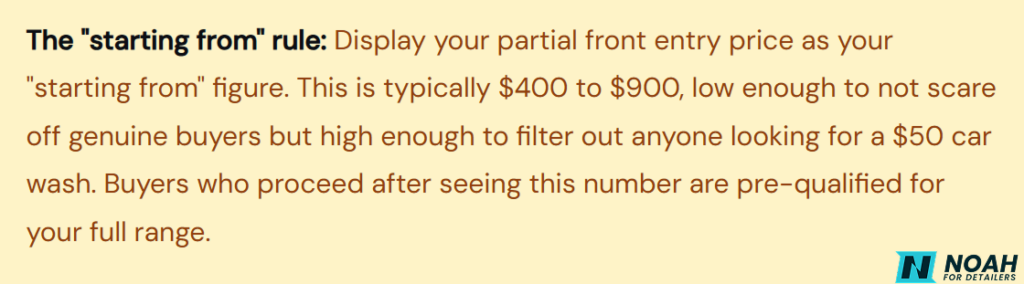
Displaying a “starting from $450” price on the page filters out price shoppers before they even enquire, which saves your consultation time for serious buyers. Studios that hide pricing get more low-quality leads, not more leads.
Include a before/after gallery
The single element that converts the highest percentage of visitors into enquiries on a PPF page is before/after photos of real work on real cars. Generic product images do not build trust. Your own work does.
Add a qualifying enquiry form
Ask for the vehicle make, model, year, and the package they are considering. This pre-qualifies the enquiry and reduces wasted consultation time on buyers who are not yet ready to commit. If you need help building a conversion page, our website detailing service covers exactly this.
2. Optimize Google Business Profile for PPF Leads
Your Google Business Profile is the most important free PPF marketing asset you have, and most auto detailers use about 20% of its potential. When someone searches “paint protection film near me” or “PPF installer [city]“, the three businesses that appear in the local map pack get the vast majority of clicks. Getting into that map pack for PPF keywords is entirely achievable for most studios, and the steps to do it are specific.
The PPF-specific GBP optimization checklist
- Add “Paint Protection Film” as a primary service in your GBP services section. Many studios list only “Auto Detailing,” which does not signal PPF capability to Google’s local algorithm.
- Upload before/after PPF photos weekly. GBP rewards active profiles with higher map pack rankings. PPF photos specifically show Google that you are actively performing this service.
- Use “PPF“, “clear bra“, and “paint protection film” in your business description. Google crawls this description for service-relevant keywords and factors it into local rankings.
- Ask every PPF client to mention the service in their review. Reviews containing the phrase “paint protection film” or “PPF” act as service-specific social proof and reinforce your relevance for those keywords.
- Post PPF-related GBP updates weekly. Use the “What’s new” post type to share completed PPF jobs with photos, approximate price, and vehicle details. These posts index in Google search and can appear in the knowledge panel.
3. Turn Every PPF Job Into Before-and-After Content
PPF is a visual service. Buyers want to see real vehicles, real installs, and real results before they trust an installer.
Every completed PPF job should become content for your website, Google Business Profile, Instagram, Facebook, and sales follow-up.
The mistake most installers make with their photo content is treating it as a portfolio archive, uploading twenty photos and then doing nothing with them. A systematic approach to before/after content creation turns every completed PPF installation into a multi-channel marketing asset.
The 5-point PPF photo distribution system
- Instagram Reels (15 to 30 seconds): Show the transformation from damaged paint to protected finish. Caption the vehicle make, model, package tier, and city. Tag the vehicle brand’s official account. These consistently outperform static posts in reach.
- Google Business Profile post: Upload the same before/after pair as a GBP “What’s new” post within 24 hours of job completion. Include the vehicle, city, and service performed in the post text.
- Website PPF gallery: Add every completed job to a rolling gallery on your PPF service page. New content signals to Google that the page is actively maintained, which improves ranking over time.
- Google review request: Send every PPF client a review request within 48 hours of job completion, when the satisfaction is highest. Link directly to your GBP review page. Aim for the review to mention the specific service.
- Facebook car enthusiast groups: Share completed exotic and luxury PPF jobs in relevant local car groups. These communities often have tens of thousands of engaged members, and the organic reach is far higher than on business pages.
4. Use Meta Ads to Reach New Car and Luxury Vehicle Owners
Meta Ads can work for PPF, but they should not be written like basic detailing ads. PPF buyers usually need education before they submit a quote request.
The ad should explain the problem, show the solution, and send the visitor to a dedicated PPF landing page.
Meta Ads can be effective for reaching luxury, EV, and new vehicle owners when the targeting, creative, and landing page are aligned.
For a broader context on running effective campaigns for your studio, our Meta Ads service page covers the full campaign architecture. For PPF specifically, the targeting approach differs from general detailing campaigns in three key ways.
Layer luxury vehicle interests
Target audiences with interests in BMW, Mercedes-Benz, Audi, Porsche, Tesla, and Lexus rather than “automobiles” in general. These owners have vehicles worth protecting and the disposable income to afford PPF at market rates.
Use “new car” life event targeting
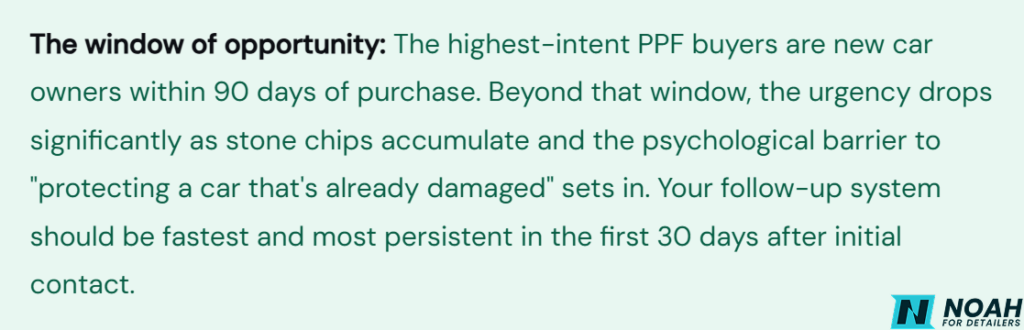
Facebook/Meta allows targeting of users who have recently purchased a vehicle (within the last 6 months). New car owners represent the highest-intent PPF audience because the window for “installing PPF on a new car” is time-sensitive. This is the most valuable targeting layer available for PPF.
Use an education-first creative approach
PPF ad creative must answer “what is this?” before it can sell. The highest-converting PPF ads start with a pain-point hook (“Rocks and road debris are destroying your new paint right now“), explain PPF in one sentence, and show a dramatic before/after transformation. Ads that open with a price or service name without context generate low-quality leads.
Lead to a dedicated PPF landing page
Never send PPF ad traffic to your homepage. A dedicated landing page for your PPF installation service, with starting prices, photo proof, and a single qualifying form, will convert at 3x to 5x the rate of a homepage for this specific service.
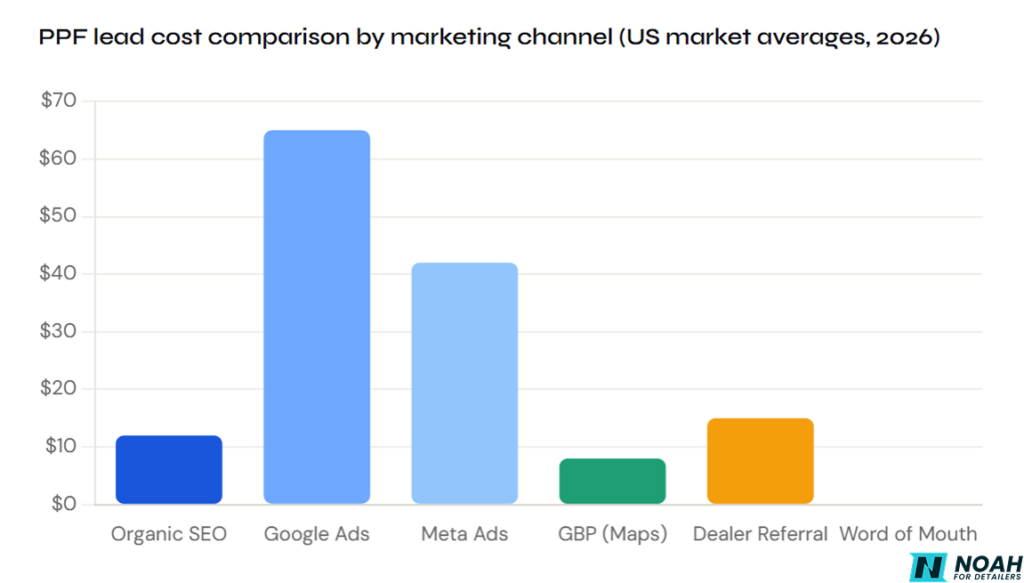
Chart 1: Average cost per qualified PPF lead by marketing channel for US-based auto detailing studios. Organic SEO has the highest setup investment but the lowest long-term cost per lead. Meta Ads deliver faster results at a higher per-lead cost. Data based on aggregated detailing industry benchmarks.
5. Using Pricing as a Filter, Not Just a Quote
Your pricing strategy is also your most powerful PPF marketing filter. How you structure, communicate, and display your pricing directly determines the quality of clients who contact you. Studios that hide pricing attract the most enquiries but waste the most time on price shoppers. Studios that display transparent, value-framed pricing receive fewer but far higher-quality enquiries.
This matters because the average PPF consultation takes 20 to 45 minutes. If your PPF marketing brings in ten enquiries per week but seven of them are from people who cannot afford or are not serious about a $3,000 investment, you are burning twelve hours a month on dead-end consultations. The answer is not fewer enquiries. The answer is a pricing strategy that filters at the entry point. Our guide on attracting ceramic coating clients covers the broader qualification framework, which applies equally to PPF.
| Pricing Display Approach | Lead Volume Effect | Lead Quality Effect | Recommended For |
|---|---|---|---|
| No pricing shown | Highest volume | Lowest quality (many price shoppers) | Not recommended for PPF |
| “Starting from $X” | Medium-high volume | Good quality (filters out low-intent buyers) | Recommended as minimum |
| Package tiers with specific prices | Medium volume | High quality (buyers self-select) | Studios with defined packages |
| Consultation required for quote | Lower volume | Highest quality (serious buyers only) | Premium/exotic vehicle specialists |
The effect of different pricing display strategies on PPF enquiry volume and quality. For most US auto detailing studios, the “starting from” approach offers the best balance between lead volume and pre-qualification. XPEL’s January 2026 national dealer survey confirms that showing starting prices increases purchase intent among serious buyers.
6. Creating Dealership Partnerships That Send You Ready-to-Buy Clients
Car dealerships are one of the most underused PPF marketing channels available to independent installers. When a customer buys a new vehicle, especially a luxury car priced above $50,000, they are in the exact mental state that PPF requires. They have just made a significant investment. They care about protecting it. They have a spending budget remaining. And critically, the salesperson they just spent two hours with has enormous influence over what add-ons they consider.
A formalized referral relationship with one or two local dealerships can deliver 3 to 8 qualified PPF inquiries per month without any ad spend. PPF resale value data from XPEL released in January 2026 shows that PPF can increase a vehicle’s resale value by up to 15%, a compelling data point that makes the dealership sales pitch almost effortless.
How to build your dealership partnership
- Approach the finance and insurance (F&I) manager, not the general manager. F&I managers handle add-ons at the point of sale and are incentivized to offer protection packages to every buyer.
- Offer to provide a free PPF demonstration on a showroom vehicle. This gives the dealership staff first-hand experience of the product and makes them credible advocates with their customers.
- Create co-branded printed materials (a simple brochure is fine) that the dealership can hand to customers who purchase luxury or sports vehicles.
- Pay a flat referral fee per completed installation, not per lead. This aligns incentives because the dealership earns only when a job is actually completed.
7. Educating the Market With Content That Ranks
Because PPF buyers need education before they can be converted, content marketing is disproportionately effective as a PPF marketing channel compared to most other services. Blog posts, videos, and FAQ pages that answer the questions buyers are already asking bring in organic traffic that is pre-qualified by the nature of the question itself.
The questions auto detailers should be targeting with content include comparison queries (PPF vs ceramic coating, full wrap vs partial front), process queries (how long does PPF take to install, does PPF change car color), and cost queries (how much does full car PPF cost, is PPF worth it for a 5-year-old car). These are not hard to rank for. Most of the current search results for these queries are manufacturer marketing pages, not independent expert guides. A well-structured blog post from a working installer carries genuine authority that product pages cannot replicate.
Your SEO detailing strategy should include at least three PPF-focused content pieces targeting different stages of buyer awareness. Pair that content with internal links to your PPF service page, and you create a funnel that moves readers from awareness to enquiry within a single session.
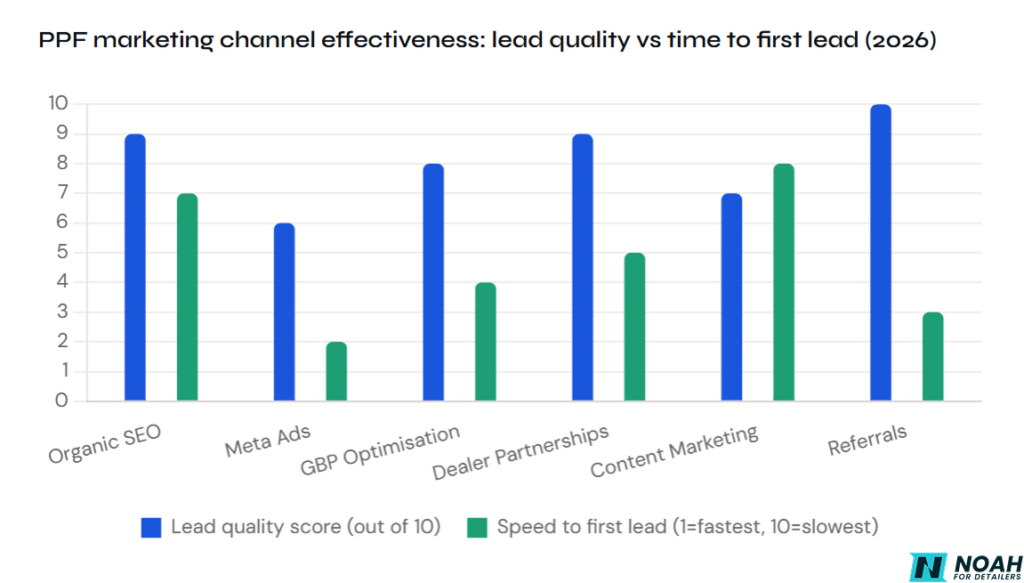
The chart above shows a comparison of PPF marketing channels across two critical dimensions: the quality of leads generated and the time required to see the first result. SEO and dealer partnerships deliver the highest quality leads but require the most setup time. Meta Ads and GBP deliver faster early results and should anchor the short-term strategy while SEO compounds.
8. Following Up and Retargeting to Close More Jobs
The average PPF buyer considers the investment for 3 to 6 weeks before committing. They visit your website, look at the before/after photos, check the pricing, and then leave to think about it. Without a retargeting and follow-up system, you lose that buyer to whichever competitor they happen to find during their consideration period.
A basic but effective PPF marketing retargeting system has three components working together. First, a Meta Pixel installed on your website captures every visitor to your PPF service page and lets you serve them follow-up ads featuring your work, social proof, and a softer CTA (“see how we protected a 2025 Porsche 911 last week”).
Second, a simple email or SMS follow-up sequence is sent to every PPF inquiry that didn’t book within 72 hours, offering a brief educational response to address common objections. Third, a re-enquiry prompt is sent 30 days after a failed consultation, referencing a new piece of work you have completed. Many PPF jobs close on the third or fourth touchpoint, not the first.
How PPF Customers Actually Research Before Buying
Most PPF buyers in the United States do not make a decision in a single visit. Unlike lower-ticket detailing services, paint protection film is a considered purchase that typically unfolds over several stages.
The first stage is problem awareness. This is where buyers search for terms like “how to protect car paint” or “rock chips on new car.” At this point, they are not looking for a PPF installer. They are trying to understand the problem.
The second stage is solution discovery. Here, buyers begin to encounter terms like “clear bra,” “paint protection film,” and “PPF vs ceramic coating.” This is where education matters most. If your content explains the solution clearly, you become the trusted source early in their journey.
The third stage is provider comparison. Now the searches become local and commercial:
- “PPF installer near me”
- “paint protection film cost [city]”
- “Best PPF for Tesla Model 3.”
At this stage, buyers are comparing:
- Pricing
- Previous work
- Reviews
- Trust signals
Finally, there is the decision stage, where the buyer chooses among 2–3 installers. This is where:
- Before/after photos
- Reviews mentioning PPF
- Clear pricing
have the biggest impact.
Understanding this journey is critical. The studios that win are not just visible at the final stage—they show up at every stage of research.
Choosing the Right Marketing Channels Based on Your Stage
Not every auto detailing business should use the same marketing channels at the same time. The right approach depends on your current stage of growth.
If you are just starting or have a limited online presence, your focus should be on foundational channels:
- A dedicated PPF service page
- Google Business Profile optimization
- Consistent before/after content
These channels build long-term visibility and trust.
If you already have traffic but inconsistent leads, the focus should shift to conversion optimization:
- Better pricing presentation
- Stronger before/after proof
- A qualifying enquiry process
If you are looking to scale beyond word of mouth, you can layer in growth channels:
- Meta Ads targeting new car owners
- Dealership partnerships
- Retargeting campaigns
The key is sequencing. Many installers jump straight into paid ads without a strong foundation, which results in wasted spend and low-quality leads.
The most effective PPF marketing systems are built in layers, not all at once.
Building a Complete PPF Marketing System (Step-by-Step)
A high-performing PPF marketing system is not a single tactic. It is a combination of channels that work together to capture, educate, and convert buyers.
- Step 1: Capture demand. Start by building a dedicated PPF service page and optimizing your Google Business Profile. This ensures you appear when buyers actively search for installation services.
- Step 2: Build trust. Use before/after content, reviews, and real job documentation to show proof of your work. This is what turns traffic into enquiries.
- Step 3: Educate buyers. Create content that answers common questions about PPF, including cost, benefits, and comparisons. This brings in early-stage traffic and positions you as an authority.
- Step 4: Generate additional demand. Layer in Meta Ads targeting high-value vehicle owners and new car buyers. This accelerates lead flow beyond organic search.
- Step 5: Convert and follow up. Implement a structured enquiry process, retargeting ads, and follow-up messages to close leads that do not convert immediately.
When these components are combined, the result is a system where each part reinforces the others. Organic traffic feeds retargeting, content builds trust, and ads amplify reach.
Building Your Complete PPF Marketing System for Auto Detailers
Not every studio should implement all eight simultaneously. Prioritize based on where you are in your business right now. If you have no online presence, start with the service page and GBP (strategies 1 and 2). If you have traffic but low conversion, focus on before/after content and pricing (strategies 3 and 5). If you want to scale past word of mouth, add Meta Ads and dealer partnerships (strategies 4 and 6).
The studios that consistently dominate their local PPF markets are not running better ads than their competitors. They have built a system where every component reinforces every other component, and the compounding effect makes them almost impossible to displace once established. If you want help building that system for your studio, our detailing SEO and Meta Ads services are built specifically for ceramic coating, PPF, and paint correction studios.
Common PPF Marketing Mistakes That Cost You Lead
Many PPF installers struggle with marketing, not because of a lack of effort, but because of a few critical mistakes.
- One of the most common is treating PPF like a standard detailing service. PPF requires education, and skipping that step leads to low-quality enquiries and poor conversion rates.
- Another mistake is directing traffic to a generic homepage rather than a dedicated PPF service page. This creates confusion and reduces conversion.
- Many installers also hide their pricing, which increases enquiry volume but attracts unqualified leads. Clear starting prices filter out buyers who are not ready to invest.
- A lack of consistent before/after content is another major issue. Buyers want to see real results, not stock images or product photos.
- Finally, many businesses ignore follow-up and retargeting, losing potential customers who are still in the decision phase.
Avoiding these mistakes alone can significantly improve both lead quality and conversion rate without increasing your marketing spend.
Conclusion
PPF marketing works when it respects the reality of how buyers discover, research, and ultimately commit to a $2,000 to $8,000 investment in their vehicle’s protection. That means building education into every channel, from a service page that answers every buyer question through to Meta Ads creative that explains the product before selling it. The studios that dominate their local PPF markets are not louder than their competitors. They are more present at every stage of the buyer’s journey.
Start with your Google Business Profile and a dedicated PPF service page. Add systematic before/after photo distribution. Build one dealer relationship. Then add paid channels once your organic foundation is converting. The market is growing, the competition among installers for online visibility is still low, and the window to establish authority in your local PPF market is open right now. The steps above give you everything you need to own it.
Frequently Asked Questions: PPF Marketing for Auto Detailers
What is the best way to get PPF leads in the United States?
The most effective way to get PPF leads is by combining a dedicated service page, Google Business Profile optimization, and consistent before-and-after content. These channels capture high-intent search traffic and build trust with potential customers. Paid ads and dealership partnerships can then be added to scale lead generation.
How much does PPF marketing cost for auto detailers?
PPF marketing costs vary depending on the channel. Organic strategies like SEO and Google Business Profile require time but have low ongoing costs. Paid channels such as Meta Ads typically require $500 to $1,000 per month to generate consistent leads in most U.S. markets.
Why are my PPF ads getting clicks but no bookings?
This usually happens when the ad does not educate the buyer or the landing page is not optimized for conversions. Common issues include sending traffic to a homepage instead of a dedicated PPF page, unclear pricing, and a lack of before-and-after proof.
How do I get PPF leads from car dealerships?
The most effective approach is to build relationships with finance and insurance managers at local dealerships. Offering referral incentives and demonstrating PPF on showroom vehicles can help generate consistent, high-quality leads.
Is SEO or Meta Ads better for PPF marketing?
SEO generates higher-quality leads over time by capturing buyers who are actively searching for PPF services. Meta Ads deliver faster results and are effective for targeting new car owners. The best approach is to use both together as part of a complete marketing system.
Is PPF worth it for a new car in 2026?
Yes, PPF is worth it for most new car owners, particularly those purchasing vehicles over $40,000 or EVs with expensive paint finishes. The film protects against rock chips, road debris, and light scratches that are otherwise permanent and expensive to repair. Given that a full repaint on a luxury vehicle can cost $5,000 to $15,000, a one-time PPF investment between $2,000 and $5,000 makes strong financial sense for protecting long-term resale value.
