


If you run an auto detailing studio and you are trying to decide where to spend your ad budget in 2026, you are probably going to land on the same question every other detailer asks: Google Ads or Meta Ads?
Both platforms can generate real leads for ceramic coating, PPF, and paint correction services. But they work in very different ways, and spending on the wrong one at the wrong time can drain your budget before you see a single enquiry.
This guide gives you a clear, practical breakdown of how Google Ads and Meta Ads work specifically for auto detailers.
Whether you have never run a paid campaign before or you have tried ads in the past and did not see the results you expected, this guide will help you understand which platform fits your current situation and how to use both together once you are ready.
Key Takeaways:
- Google Ads for auto detailers captures high-intent local customers already searching for ceramic coating, PPF, and paint correction services.
- Meta Ads for auto detailers build brand awareness and generate leads from people who are not yet actively searching but match your ideal customer profile.
- Google Ads typically delivers faster results for auto detailers with an established website and a clear offer. Meta Ads take longer to optimise but can reach a larger audience at a lower cost per click.
- For new detailing studios with a limited budget, Google Ads is the stronger starting point because it targets buyers with active intent.
- Running both platforms together creates a full-funnel strategy: Meta builds the audience, Google captures the demand.
- The biggest mistakes auto detailers make are boosting posts on Meta instead of running proper campaigns, and using broad match keywords on Google without negative keyword lists.
The Core Difference: Intent vs Interruption in Auto Detailing Ads
Before you look at budgets, targeting, or ad formats, you need to understand one fundamental difference between these two platforms. Google Ads works by capturing intent. Meta Ads works by creating it.
When someone searches “ceramic coating near me” or “PPF installer in Dublin,” they are already in buying mode. Google Ads puts your studio in front of that person at the exact moment they are looking for what you offer. That is intent-based advertising. You are not interrupting anyone. You are answering a question they are already asking.
Meta Ads, on the other hand, shows your content to people while they are scrolling through Instagram or Facebook. They were not looking for detailing services. They were looking at their friend’s holiday photos or watching a Reel. Your ad interrupts that experience. The goal is to stop the scroll, create desire, and convert someone who was not previously a buyer into one.
The short version: Google catches people who are ready to buy. Meta creates people who want to buy. Both are valuable. The right one for you right now depends on your budget, your stage of growth, and what you are trying to sell.
How Google Ads Works for Auto Detailers
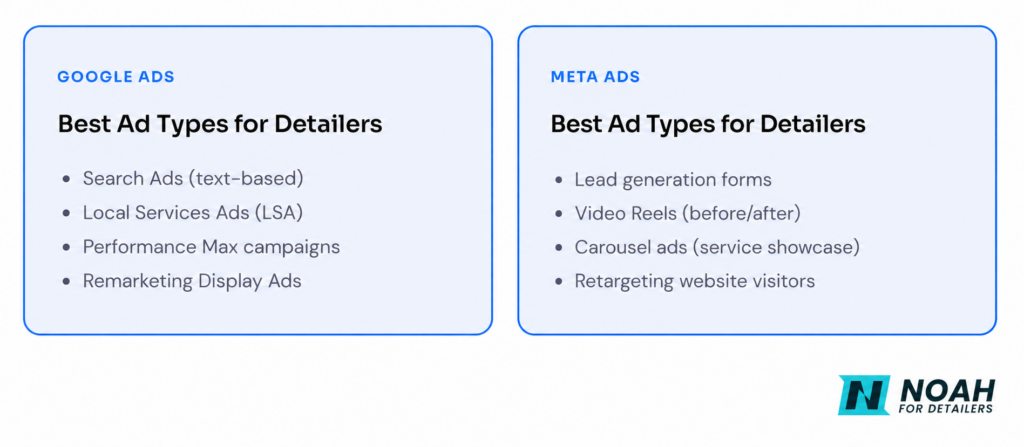
Google Ads for auto detailers primarily means Search Ads and Local Services Ads. Search Ads are the text-based results that appear at the top of Google when someone types in a query. Local Services Ads (LSAs) are the verified listings with a green “Google Guaranteed” badge that appear above standard ads for local service searches.
What keywords should auto detailers target?
The highest-converting keywords for detailing studios tend to be service-specific and location-specific. Good examples include “ceramic coating [your city],” “PPF installer near me,” “paint correction [your city],” and “mobile detailing [your area].”
These queries have strong commercial intent because the person is looking for a specific service in a specific place. Broad keywords like “car cleaning” attract low-intent traffic and drive up costs with few bookings.
For a deeper look at how SEO and keyword strategy works alongside paid ads, read is SEO still worth it for auto detailing businesses in 2026.
How much does Google Ads cost for detailers?
Cost-per-click (CPC) for detailing-related keywords typically ranges from $3 to $15 depending on your location and competition level. High-value service keywords like “ceramic coating installer” in competitive cities can push closer to $20 per click. With a conversion rate of 5 to 10 percent on a well-built landing page, a $500 monthly budget could realistically generate 3 to 8 booked consultations depending on your market.
How Meta Ads Works for Auto Detailers
Meta Ads covers Facebook and Instagram advertising through Meta’s Business Manager. For car detailers, Meta is most powerful for visual services. Ceramic coatings, paint correction, and PPF installs are all highly visual transformations, which makes them naturally suited to short video content, before-and-after posts, and Reels.
Unlike Google, Meta does not target based on what someone is searching for. It targets based on who they are. You can reach people based on their location, age, interests (car enthusiasts, luxury car owners), income bracket, and even whether they have recently visited your website. This makes Meta particularly effective for building brand recognition in your local area before a potential customer has even thought about getting their car coated.
What content works on Meta for detailing studios?
The highest-performing Meta Ads for auto detailers consistently fall into a few categories. Before-and-after videos showing paint correction or coating results perform exceptionally well because they demonstrate visible value in seconds.
Short-form Reels showing the detailing process, particularly satisfying stages like decontamination or coating application, regularly generate strong engagement. Offer-led lead form ads, where you promote a free consultation or a limited-time coating package, can drive a high volume of enquiries at low cost when targeted correctly.
If you want to see how Meta Ads fits into a broader marketing strategy for detailers, the Meta and Google Ads service page covers how Noah For Detailers structures paid campaigns for studios.
Google Ads vs Meta Ads for Auto Detailers: Head-to-Head Comparison
| Factor | Google Ads | Meta Ads |
|---|---|---|
| Targeting Type | Intent-based through keywords | Audience-based through demographics and interests |
| Speed to First Lead | Fast, usually within days Winner | Slower, usually takes weeks to optimize |
| Average Cost Per Click | $3 to $20 | $0.50 to $3 Winner |
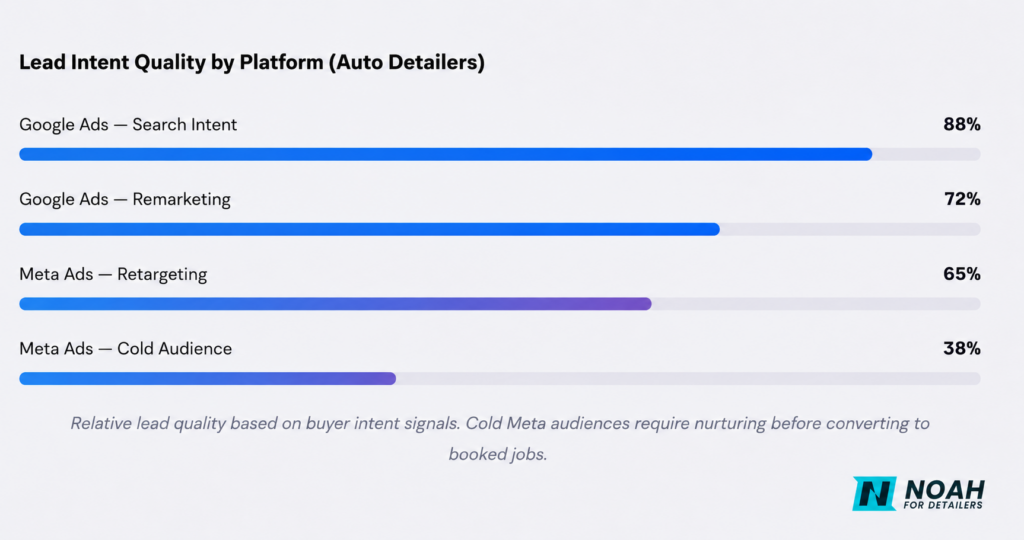
| Lead Quality | Higher intent because people are actively searching Winner | Varies and usually needs more qualification |
| Visual Content | Limited, mostly text-based | Strong with video, images, and Reels Winner |
| Brand Building | Limited | Strong for awareness, retargeting, and trust building Winner |
| Minimum Budget to Start | $500/month recommended | $300/month possible Winner |
| Learning Curve | Moderate, keyword research needed | Moderate, creative testing needed |
| Best For | Capturing ready-to-buy clients | Building audience, demand, and retargeting |
Which Platform Should Auto Detailers Start With?
The answer depends on where your detailing studio is right now. There is no universal correct choice, but there are clear patterns based on the stage of your business.
Start with Google Ads if…
- You have a working website with a clear service page
- You offer high-value services (ceramic coating, PPF) with strong margins
- You need leads quickly and do not have time for creative testing
- You are in a market where people actively search for detailing services
- You have a budget of at least $500/month to invest
Start with Meta Ads if…
- You have strong before-and-after content or video material
- You want to build brand recognition in your local area
- Your target audience is car enthusiasts who may not be actively searching yet
- You have a smaller budget and want lower cost-per-click
- You already have a Google Business Profile generating organic leads
If you are brand new to paid ads and your studio specialises in premium services like ceramic coatings or PPF, Google Ads is the safer first investment. The people clicking your ads are already in buying mode, which means less persuasion is needed to convert them into booked consultations.
For more on attracting coating clients specifically, the guide on getting ceramic coating clients covers organic and paid strategies together. You can also find platform-specific tactics in the post on ceramic coating leads without running ads.
The Full-Funnel Approach: Using Google Ads and Meta Ads Together for Auto Detailers
The most effective detailing studios do not choose one platform over the other. They use both together in a way that mirrors how customers actually make decisions. This is called a full-funnel strategy, and it works like this.
Awareness — Meta Ads (Cold Audience): A car owner in your city sees a Reel of a ceramic coating transformation on their Instagram feed. They stop scrolling. They watch the whole video. They haven’t reached out yet, but your studio is now on their radar.
↓
Consideration — Meta Ads (Retargeting): Two weeks later, Meta shows the same person a retargeted ad promoting your ceramic coating package with a clear call to action. They click through to your website and browse your services page.
↓
Intent — Google Ads (Search)A few days after that, the same person Googles “ceramic coating near me.” Your Google Search Ad appears at the top of the results. They recognise your studio name from the Meta ads they saw. They click. They book a consultation.
Meta builds familiarity. Google captures the demand that familiarity creates. Together they perform better than either platform alone.
This full-funnel approach is how professional detailing studios turn paid advertising into a reliable, repeatable lead generation system rather than a series of one-off experiments.
You can read more about building that kind of system in the 11 online marketing tips guide for auto detailers.
Common Mistakes Auto Detailers Make With Google Ads and Meta Ads
Mistakes on Google Ads
The most common and costly error is running broad match keywords without a negative keyword list. Broad match keywords like “detailing” will match your ad to searches like “detailing models” or “detailing brushes,” which are searches from hobbyists or car enthusiasts buying products, not from potential customers looking to book a service. Always use phrase match or exact match keywords for detailing campaigns, and build out a negative keyword list from day one.
Another common mistake is sending ad traffic to the homepage instead of a specific service landing page. If someone clicks an ad for “ceramic coating Dublin” and lands on your homepage, they have to find the information themselves. A dedicated landing page for ceramic coating with a clear price guide, gallery, and booking form will convert far better.
See how a proper detailing website is structured in the guide on improving your PPF website.
Mistakes on Meta Ads
The most common mistake on Meta is boosting posts. Boosting is not the same as running a proper Meta Ads campaign. A boosted post has limited targeting options, no conversion tracking, and no control over where the ad appears. Running a campaign through Meta Business Manager gives you full control over your audience, your objective, your ad placement, and your results.
A second common mistake is targeting too broadly. Detailing services are local. There is no value in your ad being shown to someone in a city two hours away. Always set tight geographic targeting around your service area, and layer in interest-based targeting such as car enthusiasts, luxury car owners, and automotive interest groups to reach the most relevant local audience.
For a wider view of what is working in auto detailing marketing right now, the post on getting more detailing customers in 2026 is worth reading alongside this guide.
Google Ads vs Meta Ads for PPF and Ceramic Coating Specifically
PPF and ceramic coating are high-consideration, high-cost services. A customer booking a full PPF wrap or a professional-grade ceramic coating is typically spending between $500 and $4,000 or more. These are not impulse purchases. The decision process usually takes days or weeks and involves research, comparison, and trust-building.
For these high-value services, the ideal platform combination is slightly different from a standard detailing studio. Meta Ads work particularly well at the top of the funnel for PPF and coating because you can show the visual result of the service to a targeted audience of car enthusiasts before they have even started researching. Google Ads then captures that audience when they move into the research and buying phase.
The PPF marketing guide for auto detailers covers this in more depth, specifically how to position PPF services online across both paid and organic channels.
What Budget Do Auto Detailers Need for Google Ads and Meta Ads?
| Budget Level | Google Ads Recommendation | Meta Ads Recommendation |
|---|---|---|
| Under $300/month | Too limited for competitive detailing keywords. Focus on SEO and Google Business Profile instead. | Possible for a small local radius. Use lead generation objective with tight geographic targeting. |
| $300 to $600/month | Viable for 2 to 3 specific service keywords in a mid-competition market. Start here if you want fast leads. | Solid starting point. Run one campaign with A/B testing on creative. Focus on retargeting warm audiences. |
| $600 to $1,500/month | Good budget for ceramic coating and PPF keywords plus remarketing. Start seeing consistent lead flow. | Run awareness and retargeting campaigns simultaneously. Test video creative vs static images. |
| Over $1,500/month | Run full-funnel Google strategy: Search, LSA, and Performance Max. Cover all high-value service keywords. | Full-funnel Meta strategy with cold audience, warm retargeting, and lookalike audiences from existing customers. |
One important note: local SEO and your Google Business Profile should be your first investment before either paid platform. If your studio is not ranking on Google Maps for local searches, you are missing leads that cost nothing per click.
Read the Google Maps ranking guide for auto detailing businesses before allocating your paid ads budget.
Frequently Asked Questions: Google Ads vs Meta Ads for Auto Detailers
Which platform generates better leads for ceramic coating services?
Google Ads generally produces higher-intent leads for ceramic coating because the person is already searching for the service. Meta Ads can generate more leads by volume at a lower cost per lead, but the enquiries require more qualification. For high-value ceramic coating jobs, Google Ads leads typically close faster and at higher ticket values.
How much should a detailing studio spend on ads per month?
A realistic starting budget for Google Ads in a competitive detailing market is $500 to $800 per month. For Meta Ads, you can start seeing results from $300 per month with tight local targeting. Most studios see the best results when they combine both platforms with a total paid ads budget of $800 to $1,500 per month alongside a strong organic presence.
Can I run both Google Ads and Meta Ads at the same time?
Yes, and for established detailing studios it is recommended. The two platforms work together rather than competing with each other. Meta builds brand recognition in your local market. Google captures the demand that recognition creates. Running both together typically reduces your overall cost per acquisition compared to relying on a single platform.
Do I need a website to run Google Ads for my detailing business?
Yes. Google Search Ads require a destination URL, and your results will be significantly better if that destination is a dedicated service landing page rather than your homepage. For Local Services Ads, you need a Google Business Profile rather than a website, making LSAs a strong option for studios still building their online presence.
What is the difference between boosting a post and running a Meta Ads campaign for detailers?
Boosting a post is a simplified version of advertising that offers limited targeting, no conversion tracking, and no control over ad placement. Running a proper Meta Ads campaign through Business Manager gives you full control over your objective (leads, website traffic, conversions), your audience, your budget allocation, and your ability to track and optimise results. For auto detailers serious about lead generation, always use Business Manager rather than the boost button.
Not sure which platform is right for your detailing studio?
Book a free strategy call with Noah For Detailers. We will review your current setup and tell you exactly where your ad budget will get the best return.Book a Free Strategy Call
