


Key Takeaways
- SEO for auto detailing businesses is still one of the highest-ROI marketing channels in 2026, averaging 700% returns for local service businesses over 12 months.
- Local SEO is especially powerful because 77% of consumers still use Google to find and evaluate local businesses before booking.
- Generic content no longer works. Niche-deep, location-specific content consistently outranks broad, generic websites in every service market.
- The real risk of SEO in 2026 is not irrelevance, it is slow build time. Expect 6 to 12 months before meaningful organic leads start coming in consistently.
- AI Overviews now appear in 55% of Google searches and cut top-position click-through rates, but local and transactional searches are far less affected than informational ones.
- If you need bookings within 30 to 60 days, pair Google Ads or Meta Ads with SEO rather than replacing SEO entirely.
- Detailers who invest in both a strong Google Business Profile and consistent blog content compound their results faster than those doing only one or the other.
Every few months a new platform, algorithm update, or AI tool triggers the same tired question: is SEO still worth it? In 2026, the question has more weight than ever because the search landscape genuinely has changed. AI Overviews are eating informational clicks, zero-click results are rising, and ranking without quality content is nearly impossible.
But here is the real answer for auto detailing businesses specifically: SEO for auto detailing businesses in 2026 is not dead, it has just matured. The detailers who went deep on niche content, optimized their local presence, and built consistent publishing habits are now reaping compound traffic that outperforms anything paid media can sustain at the same budget level.
This guide breaks down the current state of SEO, the specific data that matters for small car detailing businesses, where competitors in the U.S. market are winning and losing, and how to think about the SEO versus ads question honestly without the usual agency spin.
If you are running a one-person mobile detailing operation or a three-bay shop and want to know where to put your marketing dollars in 2026, this is the full picture.
What Has Actually Changed in Autodetailing SEO in 2026
Before deciding whether SEO is worth your time and money, you have to understand what has actually shifted since 2023 and 2024. There are three real structural changes that affect car detailing businesses specifically.
AI Overviews Are Reshaping Click Behavior
Google’s AI Overviews now appear in roughly 55% of all Google searches. For informational queries like “how long does ceramic coating last” or “what is paint correction,” AI Overviews often generate a direct answer without a click to your website.
This is a legitimate concern for purely informational blog content. However, the critical nuance for detailers is that transactional and local searches are far less disrupted. When someone types “auto detailing near me,” “best ceramic coating shop in Houston,” or “mobile car detailer open Saturday,” Google still serves map pack listings and organic results. These are the queries that book jobs, and those clicks are still flowing.
Zero-Click Searches Are Real But Overstated for Local
Around 60% of all Google searches now end without a click to any website. That number sounds alarming until you separate the search types. Weather queries, conversion calculators, sports scores, and basic definitions account for the majority of zero-click searches.
A person researching “PPF installers in Dallas” or “how much does auto detailing cost in Chicago” is still clicking through to read reviews, compare shops, and ultimately book. Local intent searches remain high-click searches. The zero-click trend affects auto detailing blogs targeting broad educational topics far more than it affects service landing pages and local content.
Generic Content Has Essentially Stopped Working
This is the most important change for small detailing websites specifically. In 2021 and 2022, you could publish a 1,000-word article titled “Why Car Detailing is Good for Your Car” and rank reasonably well in smaller markets.
That era is over. Google’s Helpful Content system and the integration of E-E-A-T signals (Experience, Expertise, Authoritativeness, Trustworthiness) now heavily reward content that demonstrates genuine expertise and specific depth.
A detailer who writes a detailed comparison of IGL Coatings versus Gyeon Quartz for daily drivers in the Phoenix heat will consistently outrank a generic “benefits of ceramic coating” article from a content farm. Small websites that go deep on a specific niche consistently outperform those trying to cover everything.
As noted across the SEO community, this shift is exactly what makes 2026 a better environment for specialized local service providers than it was three years ago.
The Real SEO ROI Numbers for Auto Detailing Businesses in 2026
Abstract discussions about SEO are not useful. Car detailing is a local service business with a specific revenue model, so let’s look at the numbers that actually apply.
| Marketing Channel | Average ROI (12 months) | Cost Per Lead | Lead Close Rate | Traffic After Budget Stops |
|---|---|---|---|---|
| Local SEO (Organic) | 700% avg. | $15 to $35 | 14.6% | Continues |
| Google Ads (PPC) | 200% to 250% | $45 to $90 | 3% to 5% | Stops immediately |
| Meta Ads (Facebook / Instagram) | 150% to 180% | $60 to $130 | 2% to 3% | Stops immediately |
| Email Marketing | 400% avg. | $5 to $12 (retention) | 8% to 12% | Depends on list |
| Organic Social (IG/TikTok) | Variable, hard to track | Time-intensive | 1% to 4% | Algorithm dependent |
Marketing channel comparison for local auto detailing businesses. SEO ROI based on FirstPageSage and BrightEdge industry data, 2026. Cost per lead estimates represent typical ranges for detailing businesses in mid-to-large U.S. markets.
The most important column in that table is the last one. Paid ads stop generating leads the moment your budget runs out. SEO compounds over time. A blog post you publish today can continue driving booked appointments 24 months from now with zero additional spend. For a detailer running on tight margins, that compounding effect is the actual business case for investing in SEO even when results are slow at the start.
The lead close rate gap is also worth examining. Car detailing leads from organic search close at 14.6% on average. That is nearly 10 times the close rate of outbound marketing like flyers or cold canvassing, and significantly higher than paid clicks, because people arriving from organic search have already qualified themselves through the search query. They were looking for what you offer, in your area, at the moment they searched.

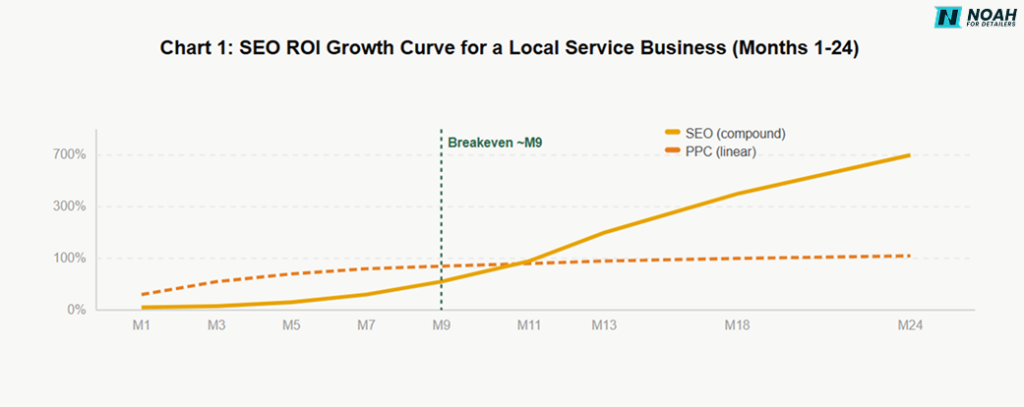
SEO ROI compounds significantly after month 9. Paid ads (PPC) deliver faster early returns but flatten over time and drop to zero when spend stops. Based on FirstPageSage 2026 benchmark data for local service businesses.
Why Local Autodetailing SEO Has a Structural Advantage in 2026
The national SEO debate around AI Overviews eating clicks is largely irrelevant to a car detailing business in Dallas, Sacramento, or Charlotte. Here is why local SEO sits in a protected segment of the search landscape.
When someone types “auto detailing near me” or “ceramic coating [city name],” Google returns a three-pack of map listings followed by organic results. AI Overviews almost never replace these results because the search intent is transactional and location-dependent.
Google cannot generate a local business listing from an AI model. It can only show what is actually there, which means real, verified, optimized businesses win. Optimizing your Google Business Profile feeds directly into this local pack visibility, and it is the single fastest ranking lever a small detailing shop has available in 2026.
The buyer psychology for car detailing also plays heavily in favor of search over social. Someone who sees a TikTok of a stunning paint correction job may appreciate it. But when they are ready to book, they go to Google and search for the service near them.
Social media builds desire; search captures the buying intent. Car detailing is not an impulse purchase in most cases. Customers research options, compare prices, read reviews, and then book. That entire research journey happens on Google, which makes being present in organic results worth far more than a viral post that sends no booking traffic.
The Niche-Down Advantage for Small Detailing Websites
One of the most powerful shifts in 2026 SEO is the reward for depth over breadth. A small car detailing website that publishes 15 deeply specific posts on ceramic coating, paint protection film, clay bar detailing, and interior odor removal in a specific city will consistently outrank a larger competitor with 200 generic posts about “how to wash your car.” Google’s systems increasingly understand topical authority.
A site that comprehensively covers one service niche in one geographic area signals expertise in a way that broad sites cannot replicate. This is genuinely excellent news for independent detailers competing against national franchise chains with large marketing budgets but thin local content.
Competitors like Detailers Roadmap and Map Ranking in the U.S. market have built their SEO service offerings around exactly this principle. They focus on tight keyword clusters per service area rather than trying to rank for everything at once. The detailers winning in competitive U.S. markets like Los Angeles, Chicago, and Miami are not the ones with the biggest websites. They are the ones with the most relevant, specific, locally anchored content. Your local SEO strategy should be built around 5 to 8 core service keywords in your specific metro area rather than 50 generic keywords nationally.
SEO vs. Google Ads for Autodetailing: When to Use Each
The honest answer to this question is that for most car detailing businesses, the right answer is both. But the timing, budget allocation, and strategic purpose of each channel are very different.
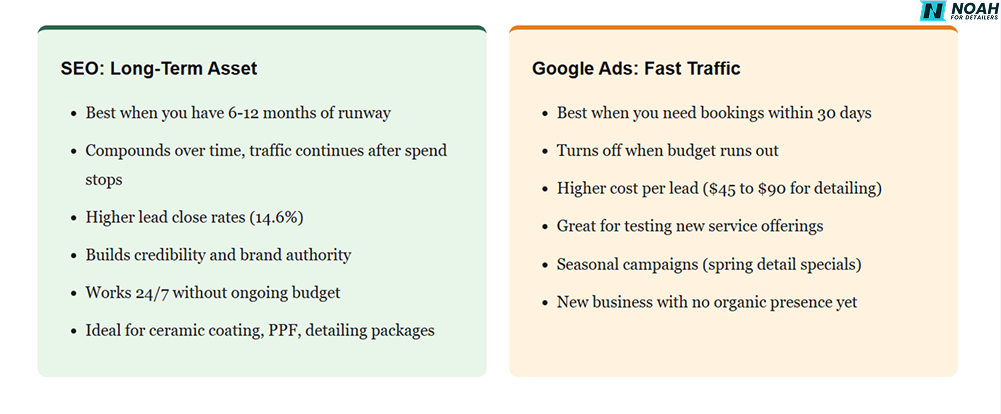
If you are a brand new detailing business with zero online presence and you need to generate revenue in the next 60 days, paid ads are the right starting point. A well-structured Google Ads campaign targeting “car detailing [your city]” can generate booked appointments within days of going live. But that traffic costs $45 to $90 per lead on average in U.S. markets, and it evaporates the moment you pause spend.
Meanwhile, an SEO campaign started at the same time will begin building authority quietly in the background, and by month 9 or 10, your organic leads will start arriving at $15 to $35 per lead with no ongoing cost.
The smartest approach for most detailers is to run Google Ads for the first 6 months while SEO builds momentum, then gradually shift budget from ads to content and link-building as organic traffic picks up. Many successful detailing businesses in the U.S. run a permanent low-budget Google Ads campaign alongside strong organic rankings specifically for high-ticket services like PPF and multi-stage paint correction, where a single job can generate $1,500 to $3,000 in revenue and easily justifies a $90 cost per lead. For routine details and maintenance washes, organic rankings produce the better economics. See how we break down ads versus organic strategy for detailing businesses in more detail.
Which Autodetailing Services Deliver the Highest SEO ROI in 2026
Not all car detailing services carry the same SEO value. The ROI calculation changes significantly depending on the average job value for each service type. Here is a breakdown of how SEO investment maps to return for typical U.S. detailing service categories.
| Service Category | Avg. Job Value (USA) | Search Volume Potential | SEO Difficulty | Estimated ROI Potential | Recommended Priority |
|---|---|---|---|---|---|
| Ceramic Coating | $800 to $2,500 | High | Medium | Very High | Priority 1 |
| Paint Protection Film (PPF) | $1,500 to $5,000+ | Medium-High | Medium-High | Very High | Priority 1 |
| Paint Correction | $400 to $1,200 | Medium | Low-Medium | High | Priority 2 |
| Full Interior Detail | $200 to $500 | High | Low | Medium-High | Priority 2 |
| Mobile Detailing | $150 to $350 | Very High | Low | High (volume-based) | Priority 2 |
| Window Tinting | $200 to $600 | High | Medium | Medium-High | Priority 3 |
| Basic Wash and Wax | $80 to $150 | High | Low | Low-Medium | Priority 4 |
SEO priority matrix for auto detailing service categories in U.S. markets. Job value ranges represent typical mid-market pricing. SEO difficulty ratings based on competitive analysis of major U.S. metro areas in 2026. Prioritize SEO investment toward the highest-ticket services first for maximum revenue return per ranking gained.
The takeaway from this table is straightforward: spend your SEO effort where the average job value is highest. Ranking on page one for “ceramic coating [your city]” is worth 10 to 20 times more per lead than ranking for “car wash near me” because the ticket value difference is that dramatic.
This is where many small car detailing websites make a critical strategic error: they focus blog content and optimization on the services they do most often (like basic washes) rather than the services that pay the most (like ceramic coating and PPF). Sound SEO strategy always starts with revenue mapping, not just search volume.
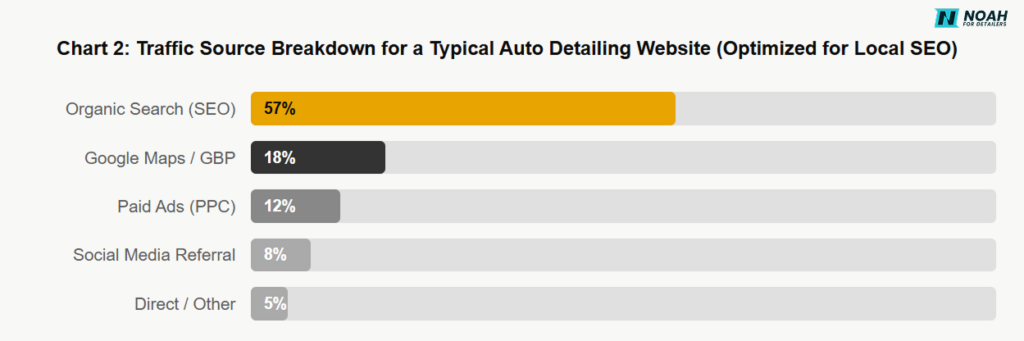
Estimated traffic source distribution for a local auto detailing website with active SEO and a fully optimized Google Business Profile. Organic search and Google Maps combined account for approximately 75% of total inbound traffic. Social media referral traffic typically converts at lower rates than organic search. Data based on industry benchmarks from BrightEdge 2026 and internal detailing website analytics patterns.
What U.S. Autodetailing SEO Competitors Are Getting Right (and What They Are Missing)
Looking at the major U.S. competitors in the detailing marketing space, there are clear patterns in what is working and what is leaving significant ranking opportunity on the table.
What Detailers Roadmap Gets Right
Detailers Roadmap, based in Brookfield, Wisconsin, is one of the most recognized SEO service providers for the U.S. detailing industry. Their strength is in tight keyword cluster strategy: they build sites around service-plus-city combinations and optimize each page individually rather than relying on a single homepage to rank for everything. Their content is also niche-specific, which aligns with the 2026 algorithm preference for topical depth. Small detailing businesses that replicate this cluster approach, even without hiring an agency, will see faster gains than those trying to rank with a single homepage.
What Most Competitors Miss
The biggest gap across most detailing marketing competitors is blog content that is written purely for keywords rather than for genuine helpfulness. You can still find articles on U.S. detailing websites that list “top 10 reasons to get your car detailed” without any specific data, images of actual work, or local references. Google’s Helpful Content framework penalizes exactly this type of content in 2026. Competitors also frequently underinvest in local citation building and schema markup, both of which directly influence map pack rankings. A well-structured Local Business schema on every service page is a quick technical win that many detailing websites still skip entirely.
The Review Strategy Gap
Another consistent gap in the U.S. detailing market: most operators are not systematically capturing Google reviews at the point of service completion. Businesses with 150 to 300 recent five-star reviews in a given city consistently dominate the local pack regardless of ad spend. Local SEO authority in 2026 is built on content quality, citation consistency, and review volume working together. Having two of the three is not enough to hold the top position in competitive markets like Miami, Houston, or New York.
How to Make SEO for Auto Detailing Worth Every Dollar in 2026
Given all of the above, here is a practical framework for making SEO work for a small car detailing business in the current environment.
Step 1: Fix Technical Foundations First
Before publishing a single blog post, your website needs to pass basic technical health checks. Core Web Vitals, mobile responsiveness, SSL security, and page load speed under 2.5 seconds are non-negotiable in 2026. A technically broken website will not rank regardless of how good the content is. Use Google Search Console to identify crawl errors and indexing issues. Fix those first. This alone can produce meaningful ranking improvements within 4 to 6 weeks without creating any new content.
Step 2: Build Service Pages Before Blog Posts
Many car detailing businesses make the mistake of blogging before they have properly optimized service pages. Your ceramic coating page, PPF page, paint correction page, and mobile detailing page are the commercial pages that directly generate revenue. Each of these needs its own page, its own keyword targeting, schema markup, and local geo-modifiers baked into the copy. Blog content supports these service pages through internal linking and topical authority, but the service pages themselves are the conversion engine. Do not spend budget on content marketing before you have a solid foundation of optimized service pages live on your site.
Step 3: Publish Niche-Deep, Location-Specific Content
Once your service pages are solid, begin building supporting blog content around buyer questions specific to your market. “How long does ceramic coating last in Phoenix heat?” is far more valuable than “benefits of ceramic coating” for a Phoenix-based detailer. Local climate, road conditions, prevalent vehicle types, and seasonal patterns are all angles that a car care blog can use to create genuinely helpful, locally relevant content that national competitors cannot replicate. Aim for two to four deeply researched posts per month rather than daily shallow posts. Consistency and depth matter more than volume in the current environment. For more on this approach, explore how local content strategy has evolved in 2026.
Step 4: Build Your Google Business Profile Aggressively
Your Google Business Profile is the single fastest lever for local search visibility in 2026. Businesses with fully completed profiles, 10 or more categories of photos, weekly posts, and consistent review responses rank meaningfully higher in the map pack than those with bare-minimum profiles. This is technically separate from on-page SEO but feeds the same local ranking algorithm. For a comprehensive walkthrough of exactly how to optimize this for a car detailing business, the upcoming Google Business Profile guide for detailers on this blog covers every setting and optimization in detail.
Step 5: Track the Right Metrics, Not Vanity Numbers
One reason many detailers give up on SEO before it works is that they are tracking the wrong numbers. Rankings fluctuate daily. Traffic spikes and dips. The metrics that actually tell you whether SEO is working for a local service business are: phone calls from organic search, form submissions from organic visitors, and Google Business Profile direction requests. If those three numbers are trending up month over month, your SEO investment is working even if rankings feel unstable week to week.
SEO for Detailing is Trending
The landscape of search has genuinely changed. Zero-click searches are real. AI Overviews are eating informational clicks. Generic content does not rank. If you are waiting for SEO to magically deliver traffic without a strategy, 2026 is not your year.
But if you are a car detailing business willing to invest in niche-deep local content, a fully optimized Google Business Profile, and a technically sound website, SEO in 2026 is one of the best long-term investments available to you.
The data is not ambiguous: organic search drives 57% of qualified traffic for local service websites, SEO leads close at nearly 10 times the rate of outbound leads, and the average local service business sees 700% ROI within 12 months of consistent effort. Those numbers hold for detailing businesses precisely because local intent searches are the most protected segment of the search landscape from AI disruption.
The formula is straightforward. Fix your technical foundation, build proper service pages, publish location-specific content on high-ticket services, grow your Google Business Profile, and collect reviews systematically. Do this consistently for 9 to 12 months and your detailing website becomes a booking machine that works while you are under a car applying a ceramic coat. If you need revenue before that happens, run ads in parallel. But never stop building the organic asset.
Ready to build an SEO strategy for your detailing business? Book a free strategy call with the Noah For Detailers team.
Frequently Asked Questions: Autodetailing SEO in 2026
Is SEO still worth it for small auto detailing businesses in 2026?
Yes, SEO is absolutely still worth it for small auto detailing businesses in 2026, particularly for local search where organic rankings and Google Business Profile visibility drive the majority of high-intent booking traffic. Local service SEO delivers an average ROI of 700% within 6 to 12 months, and SEO leads close at a 14.6% rate compared to 1.7% for outbound methods. The key shift in 2026 is that generic content no longer produces results. Detailers who publish niche-specific, locally anchored content targeting high-ticket services like ceramic coating and PPF see the strongest returns.
How long does it take for SEO to generate bookings for a car detailing business?
Most car detailing businesses begin seeing meaningful organic booking traffic between months 6 and 9 of consistent SEO effort. Technical fixes and Google Business Profile optimization can produce results faster, sometimes within 4 to 8 weeks for local map pack visibility. Competitive markets like Los Angeles, Chicago, or Miami typically take longer, closer to 9 to 12 months for strong page-one positioning. Smaller markets with less competition can see results in 3 to 5 months. Running Google Ads in parallel during the build phase is the recommended approach if you need revenue before organic traffic scales.
Should a car detailer choose SEO or Google Ads in 2026?
For most car detailing businesses, the answer is both, but at different budget allocations depending on business stage. New businesses with no online presence should prioritize Google Ads for the first 6 months to generate immediate revenue, while starting SEO in parallel. Established businesses with an existing online presence should allocate more budget to SEO for long-term compounding traffic, keeping a smaller ads budget for high-ticket services like ceramic coating and PPF where the job value easily justifies a $90 cost per lead. SEO delivers better economics over time, but paid ads fill the gap while organic rankings build.
How does AI and AI Overviews affect SEO for car detailing websites?
AI Overviews primarily affect informational search queries, not the transactional local queries that drive car detailing bookings. Searches like “auto detailing near me,” “ceramic coating [city],” and “mobile car detailer open now” still return map pack listings and organic results rather than AI-generated answers. For informational blog content on car detailing websites, AI Overviews may reduce clicks on generic educational topics. The solution is to focus content on locally specific, experience-based topics that AI cannot replicate, such as service comparisons for specific climates, real customer case studies, and location-specific pricing guides.
What is the most important SEO investment for a small detailing business right now?
In 2026, the highest-leverage SEO investment for a small car detailing business is a fully optimized Google Business Profile combined with a consistent review acquisition strategy. This directly impacts local map pack rankings, which generate 18 to 25% of total inbound traffic for detailing websites. After the GBP, the second priority is building dedicated, keyword-optimized service pages for each high-ticket service, followed by supporting blog content targeting buyer questions specific to your local market. Technical SEO health, including page speed and mobile usability, forms the foundation that makes all other work effective.

[…] For a broader explanation of local search, read our guide on SEO for auto detailing businesses. […]
[…] If you serve multiple cities, each service area should have its own dedicated page. For a full breakdown of how SEO and GBP work together, read our post on whether SEO is still worth it for auto detailers in 2026. […]
[…] Auto detailing SEO is one of the best long-term marketing strategies for car detailers. It helps your business show up when customers are already searching for your services. […]
[…] If you are deciding whether to focus on SEO or paid ads first, read our full breakdown on whether SEO is still worth it for auto detailing businesses in 2026. […]