

Lead Generation on Meta
When running performance campaigns, Meta lead generation forces critical decisions. Whether launching new campaigns or scaling existing accounts, one small choice has a massive impact. You must choose between two paths: send users off-platform to your website enquiry form for high-intent leads, or keep them in-app using native Instant Forms. Collecting leads is easy. However, this routing choice determines whether you attract casual scrollers or genuine prospects.
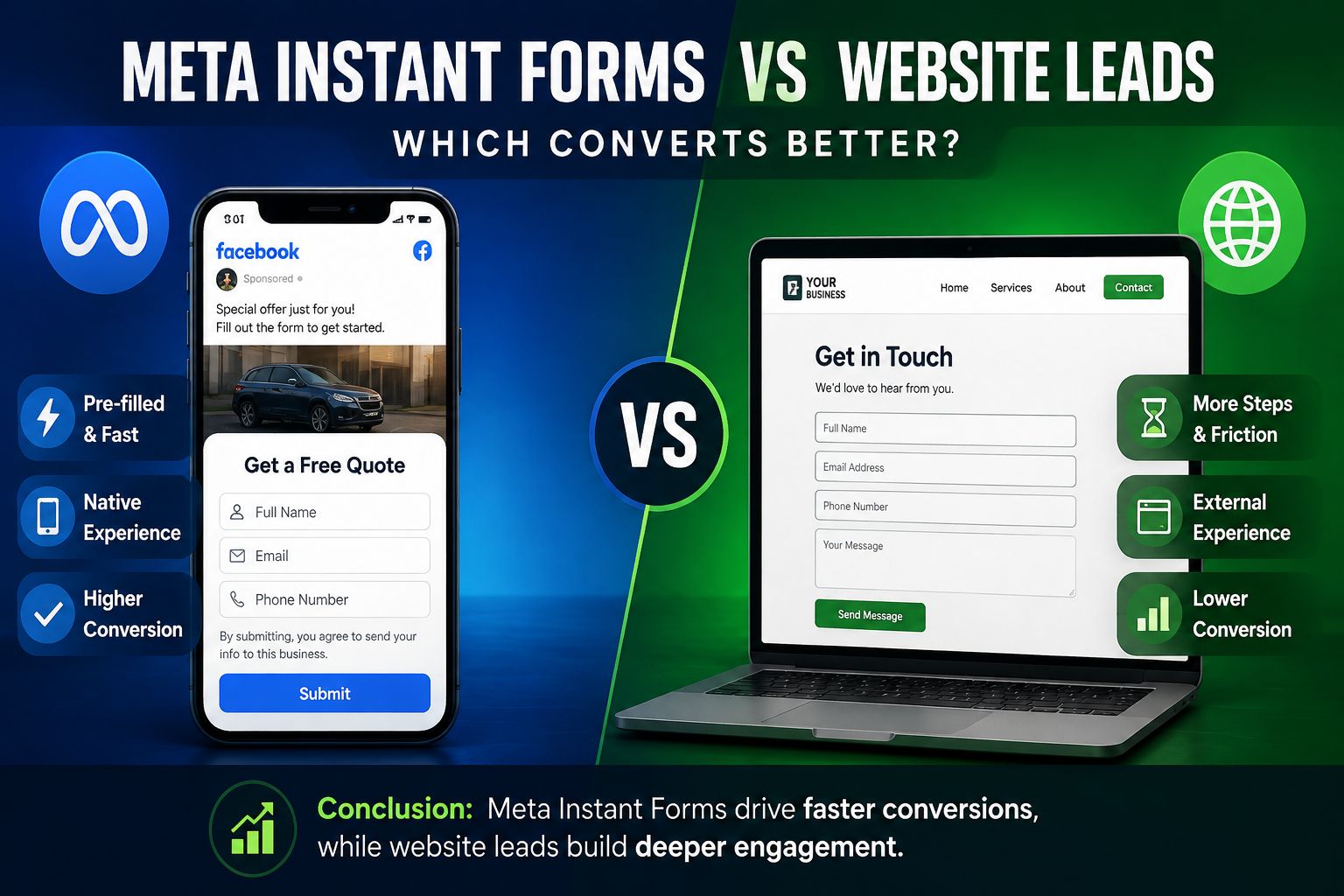
Meta Instant Forms yield faster submissions and a lower cost per acquisition. Native forms remove friction. However, raw volume does not guarantee business quality. In-app submissions often stem from casual intent, forcing your sales team to filter more cold leads. Conversely, directing traffic to an external enquiry form tests true buyer commitment. This ensures you capture prospects who understand your offer before submitting.
This dynamic creates a clear trade-off between conversion volume and lead quality. Native tools accelerate pipeline speed. In contrast, external landing pages filter out unqualified users to improve lead intent. Furthermore, tracking website visits lets you capture prospects who drop off midway. This gives you the flexibility to retarget users based on specific on-page behaviors. Profitable Meta campaigns never focus on vanity metrics alone. You must align your technical setup with your sales capacity to drive closed revenue.
Meta Instant Forms vs Website Leads: Why Low CPL Doesn’t Always Mean High Revenue
When running paid campaigns across Facebook and Instagram, choosing Instant Forms often feels like the most direct path to pipeline growth. Because these lead forms are hosted directly within Meta, they load instantly without forcing users to wait for an external website. This low-friction environment strips away technical hurdles. When someone clicks your ad, their pre-filled profile data—including verified name, personal email, and phone number—populates in seconds. For growth-focused businesses needing speed and volume, this auto-fill mechanism lifts submission rates while maintaining a low cost per lead (CPL).
Evaluating the practical pros and cons highlights why native capture excels during specific campaign stages. Deploying Meta Instant Forms accelerates your learning curve when launching top-of-funnel campaigns, building brand awareness, capturing early interest, or testing offers on low budgets. The user journey is fast and simple. Prospects review their information and submit details with a single tap. In my media buying experience, this approach quickly validates ad messaging, providing clean baseline data on audience response and conversion rates.
However, effortless submissions can introduce sales friction when evaluating prospect depth and intent. Because the barrier to entry is minimal, native Instant Forms naturally invite low-intent clicks. This often leaves sales teams with cold, unresponsive leads who barely remember sharing their data. Compared to the deliberate commitment required for qualified website leads, high submission speed does not automatically translate to commercial quality. Optimizing lead generation requires balancing total lead volume against true, revenue-generating lead quality.
Why Website Leads Outperform Instant Forms for High-Ticket Detailing Services
When scaling paid traffic across Facebook and Instagram, shifting to website forms is where serious lead qualification begins. Embracing this approach introduces deliberate friction into the conversion path. When users click your ad, loading an external page naturally filters out passive browsers. While this barrier reduces overall lead volume, prospects reaching your landing page arrive with higher intent. They absorb your branding, read testimonials, and evaluate key trust signals. This builds genuine credibility and creates a real sales pipeline rather than a list of cold data.
Evaluating the pros and cons of website leads shows why pipeline value beats sheer quantity. In my experience managing ad spend for service businesses, high-ticket offers, and niche B2B campaigns, sacrificing top-level conversion rates is often the most profitable choice. On your own site, you can use conditional logic and detailed questions to qualify leads before they reach sales reps. This filter improves overall quality. When a prospect completes the form, their commercial intent is already proven. Instead of having reps chase unverified contacts, you deliver qualified leads ready to close.
Routing traffic to your website also unlocks advanced tracking across your entire funnel. Tracking pixels provide actionable data on user engagement and ad performance. Unlike native platforms, your website lets you monitor user behavior and retarget visitors who abandon before submitting. Using this behavioral data, you can re-engage high-value prospects across multiple stages. While Instant Forms win on speed, directing Meta Ads traffic to your own website gives you complete control over data, qualification, and long-term revenue.
The Question of Intent
When auditing paid traffic, user intent separates casual clickers from genuine prospects. Native Instant Forms cater mostly to passive interest and casual users scrolling through feeds. Because Meta auto-fills profile names and contact details, the platform practically completes the form on their behalf. This explains why many users do not remember submitting an inquiry when contacted later. Understanding this dynamic changes how you evaluate incoming leads and measure true intent.
By comparison, directing Meta ads spend to external website forms generates high-conviction leads. Taking that extra step introduces friction. However, that extra effort separates warm buyers from window shoppers. Manually typing personal information ensures only prospects ready to act finalize their submission. While this friction reduces overall submission volume, the resulting leads carry unmistakably higher buying intent. When evaluating campaign profitability, a single high-intent submission is far more valuable than dozens of disengaged contacts who clicked by mistake.
In my work with sales teams, our rule of thumb comes down to pipeline capacity. If your goal is simply packing your CRM with sheer volume, native capture delivers quick leads efficiently. However, thousands of cold CRM contacts mean nothing if people refuse to answer the phone. Your follow-up success depends entirely on lead intent. If you want sales reps engaged in meaningful conversations that convert to revenue, filter for intent upfront so every sales call counts.
The Impact on Lead Quality
When running campaigns on Meta, the distinction between vanity metrics and real revenue comes down to lead quality. In performance advertising, uncalibrated accounts frequently flood inboxes with cheap leads from native Instant Forms. Seeing hundreds of leads hit your CRM feels productive on paper. However, relying solely on frictionless forms forces your sales team into heavy filtering and tedious nurturing. If your sales process cannot chase cold contacts around the clock, sorting through unverified submissions becomes frustrating. For detailing businesses, this is the dividing line: you either profit from customer acquisition or waste money burning sales hours on low-quality prospects.
Switching ad delivery to capture verified website leads through dedicated forms solves this volume trap with intentional friction. Because external forms require conscious effort, they naturally filter out uncommitted tire-kickers scrolling social feeds. By adding targeted custom questions, you qualify interest before a visitor submits contact details. Asking pointed questions about the requested service, vehicle make and model, or expected booking timeline validates buyer interest in real time. This upfront filtering gives your estimators total control over incoming submissions, ensuring your pipeline prioritizes committed vehicle owners over casual browsers.
Adding dynamic conditional logic turns your landing page into an automated pre-screening tool. When your form presents follow-up questions based on previous answers, it adapts seamlessly to the scope of the project. For example, if a prospect selects Ceramic Coating, the form can automatically prompt them for the vehicle’s year, make, and current paint condition (such as visible swirl marks, oxidation, or scratch depth). If they choose Paint Protection Film (PPF), it immediately asks for their preferred coverage level—such as full front clip, track pack, or full body wrap—and whether multi-stage paint correction is required beforehand. These tailored follow-up questions deliver high-value vehicle details straight to your closing team while feeding rich conversion data back to your Meta pixel. Elevating your pipeline this way ensures ongoing campaign optimization feeds your business ready-to-book clients rather than empty clicks.
Retargeting and Tracking Opportunities
When planning media spend on Meta, evaluating retargeting and tracking opportunities is foundational to your long-term strategy. With native Instant Forms, visibility into user behavior remains strictly quarantined inside the platform. You can see whether a prospect opened or submitted a form. However, Meta restricts broader retargeting and in-depth tracking. Without granular on-site data, you miss the behavioral depth needed to retarget users based on actual intent. While native forms deliver speed, relying solely on basic submissions limits your overall campaign strategy.
Directing ad traffic to website forms unlocks far greater operational flexibility. When users interact with your funnel, your pixel captures every touchpoint. It tracks landing page visits, CTA clicks, and abandoned forms. This detailed on-site data reveals how prospects explore service pages, what holds their attention, and what triggers drop-offs. In my agency experience, tracking these actions is crucial for recovering lost conversions across competitive campaigns.
This behavioral data empowers you to build full-funnel remarketing campaigns that turn cold traffic into closed revenue. Instead of guessing why a prospect hesitated, you can serve targeted ads to users who viewed specific pages without converting. Warming up users over time creates distinct conversion pathways, turning lost interest into closed deals. While in-app capture has its place, robust web tracking and precise retargeting give your Meta ads the edge needed for scalable customer acquisition.
Using Both — The Hybrid Approach
When running paid acquisition, media buyers often debate whether to push traffic to website leads or use native Instant Forms. In my experience auditing top-performing accounts, the highest ROAS rarely comes from choosing just one path. Instead, real leverage comes from combining both into a hybrid approach. Balancing each format’s strengths across different campaigns transforms how you build and scale your pipeline.
In Stage 1, we run native Instant Form campaigns on Meta to generate awareness and collect high volumes of low-cost leads. On-platform forms eliminate landing page load times, maximizing quick submissions and top-of-funnel reach. These initial ads attract a broad audience, generating steady leads at an efficient cost. Although casual clicks yield mixed intent, they quickly populate custom audiences for the next phase.
In Stage 2, we retarget engaged users using refined Custom Audiences. Here, we direct traffic to a dedicated website form to foster deeper engagement. When prospects explore detailed site pages from search or targeted ads, their buying intent is significantly stronger. This hybrid setup maximizes each tool’s strengths. Your sales reps can focus direct, qualified follow-up on high-value prospects ready to convert.
To scale across multi-channel accounts, you can also retarget users by syncing social data with search intent on Google Ads. Processing verified submissions through your CRM ensures responsive follow-up that nurtures cold prospects into active buyers. Using this hybrid approach empowers you to retarget prospects across touchpoints while protecting your overall customer acquisition cost.
Instant Forms Conversion Rate vs ROI
When running Meta ads, the temptation is to prioritize a low cost per lead (CPL). However, ignoring the full story is an expensive trap. In my client campaigns at Noah for detailers , I often see advertisers celebrate a £4 lead from an Instant Form. Weeks later, they realize their sales team is stuck chasing low-quality leads who never reply. A native setup lowers headline costs. However, when cheap leads produce ghosted calls and empty quotes, your overall return on ad spend (ROAS) collapses. Pushing targeted prospects directly to an optimized website landing page naturally filters out low-quality leads from the start of your pipeline.
To uncover the real ROI, you need disciplined campaign measurement across every step of the buyer journey rather than focusing on surface metrics. Driving prospects to website forms might yield a pricier £14 lead. However, that prospect invested time to read your copy and is far more primed to convert into a job. When evaluating the funnel, we track progression from lead-to-call rate, to call-to-quote rate, and finally to quote-to-sale rate. Optimizing these sequential rates proves that engaged users directly elevate your ultimate lead-to-sale conversion rate.
Balancing total ad spend against verified cash collected separates sustainable growth from wasted money. Allocating budget to top-of-funnel vanity metrics creates heavy backend costs while reps waste hours chasing unresponsive leads. However, when one vetted enquiry turns into a profitable £2,000 job, that single close delivers high-margin revenue and a superior ROI. Evaluating performance on closed revenue rather than opt-in volume ensures every budget decision builds genuine, scalable profit.
Which Should You Use?
When auditing paid traffic accounts at Noah for detailers, one question dominates our campaign strategy: should you launch Meta ads using frictionless Instant Forms or dedicated website leads? If you are starting out or validating a new offer, native in-app forms are fast to deploy and simple to test. Auto-filled fields quickly attract casual scrollers, letting advertisers secure quick traction and collect essential data within days. For newer clients needing immediate traction and high lead volume, frictionless deployment delivers swift baseline data. This helps you optimize ad creatives before committing to heavier infrastructure.
However, prioritizing raw numbers over buyer intent often backfires. Transitioning to website forms becomes vital once you prioritize lead quality over volume. Directing prospective buyers to a solid website gives them space to review case studies, pricing, and clear trust signals. This naturally filters out tire-kickers. By using an advanced form setup with conditional logic, you can ask specific qualifying questions. This turns casual prospects into vetted, double-qualified leads. While adding friction reduces top-line submissions, the right setup ensures your pipeline is filled with high-intent, sales-qualified leads. Striking this balance protects operational focus and guarantees high backend lead quality from day one.
Ultimately, deciding which route to take across your funnel is not an all-or-nothing debate. Nor is it about blindly switching forms when conversion rates stall. The most profitable strategy integrates the best of both worlds. First, capture top-of-funnel prospects quickly via in-platform lead generation. Then, connect them directly to your database using a robust Meta Ads CRM integration. From there, a proper follow-up process ensures no prospect falls through the cracks. Seamless CRM integration enables your team to track results, assess conversion velocity across the wider funnel, and refine your sales process. Supporting both options with disciplined follow-up and tracking tangible revenue eliminates guesswork, building a scalable acquisition engine tailored to your business stage.