

You drop $1,500 on Meta ads, sit back, and wait for your shop phone to ring. By Friday, your inbox is flooded with messages asking if you can buff out deep key scratches on a rusty 2004 sedan for forty bucks.
You want multi-stage paint correction and four-figure ceramic packages. Instead, you are stuck arguing over pet hair with someone who thinks an eighty-dollar full detail is highway robbery.
Running a profitable detailing business is never about casting the widest net possible. When you speak to everyone with four wheels and a dirty windshield, you end up competing strictly on price with the guy working out of the trunk of his car.
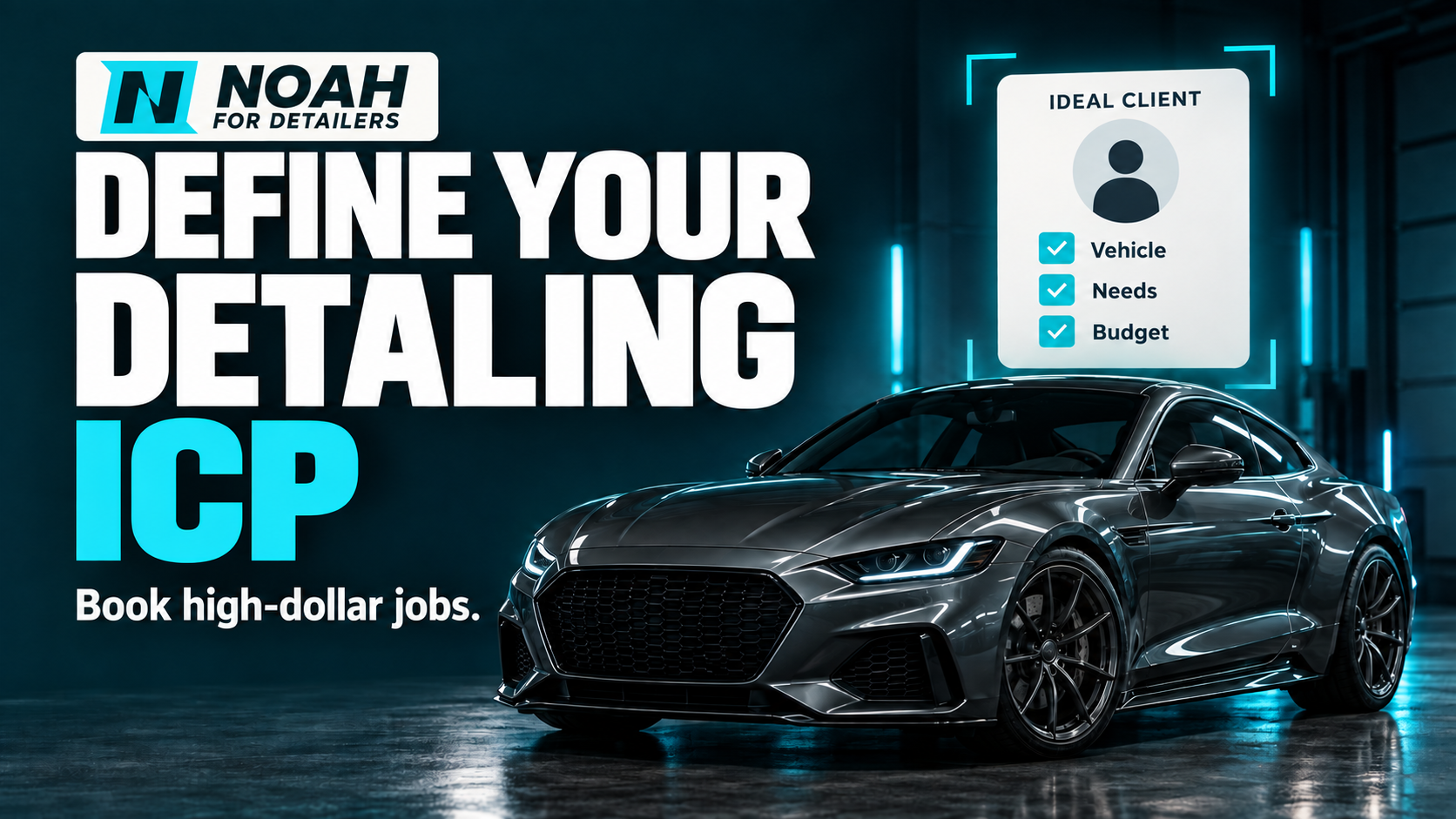
Before you burn another dollar on digital campaigns, you need an Ideal Client Profile (ICP). Getting this right transforms your customer acquisition from a stressful guessing game into an intentional, high-margin machine.
What an ICP Actually Means for Your Detailing Business
Your ICP is simply a description of the best type of customer for your detailing business. Think of it like a dating profile for your shop.
Instead of searching for a romantic partner with specific quirks and shared hobbies, you are defining the exact person you want pulling into your bays every Monday morning. You are detailing their vehicle, their budget, their pain points, and their expectations.
When you date without standards, you end up miserable. The same reality applies to your garage bays.
If your marketing treats an exhausted parent driving a crumb-filled minivan the exact same way as a weekend enthusiast with a Porsche Cayman, your messaging falls flat for both. One wants sanitization and fast turnarounds; the other wants paint depth, zero swirl marks, and hydrophobic coatings. An ICP forces you to pick a lane so your messaging cuts through the noise.
The Three Core Questions to Build Your Profile
Building your ICP does not require an MBA or expensive market research software. You can build yours right now by answering three straightforward questions:
1. What kind of car do they own?
Get specific here. “Nice cars” is not an answer.
Are they driving a leased BMW 5-Series that needs to look pristine for executive clients? Is it a lifted Ford F-250 used on construction sites, requiring durable interior protection and regular maintenance? Or is it a vintage weekend cruiser that only sees asphalt between April and October?
The vehicle dictates the exact services you can sell. It also reveals how the owner views automotive care: an unavoidable chore, a functional necessity, or a personal passion.
2. What’s their problem that you could solve?
Nobody buys a detail just to spend money; they buy an outcome.
Your customer might be embarrassed to take business partners to lunch because their leather seats look greasy and worn. They might be terrified of rock chips ruining the hood of their brand-new Corvette on track days. Or maybe they simply work sixty hours a week and value their Saturday mornings with their kids far more than spending four hours washing an SUV in the driveway.
Identify the emotional friction. When you solve a real headache rather than selling “soap and water,” price resistance fades.
3. Why are you the right solution or why should they choose you?
Why your shop? What makes you the obvious choice over the mobile detailer charging half your rates?
Perhaps you operate a dedicated, climate-controlled clean room with proper inspection lighting. Maybe you hold certified installer credentials for a premier coating brand with legitimate warranty backing. Or maybe your operations run like clockwork, offering loaner cars and seamless digital check-ins that respect their schedule.
State your actual competitive edge plainly. If your only differentiator is “we care more,” keep digging until you find a tangible reason.
The Reality Checks: Distance and Affordability
Once you answer those three questions, add two filters that determine whether a prospect is actually viable.
First: how many miles are they from your shop?
Geography sets hard boundaries in the service industry. A customer might love your Instagram reels, but they will not drive 45 minutes across town during rush hour for an express maintenance wash.
High-ticket services like full-vehicle paint protection film (PPF) expand your radius because owners will travel for specialized artistry. Maintenance work, however, relies on tight geographic convenience. Know your perimeter.
Second, and most importantly: are they willing and able to afford your services?
Need does not equal buying power. A beat-up work van desperately needs a carpet extraction and torn-fabric repair, but the owner will rarely justify a $400 bill.
Your ideal client must have the disposable income to pay your rates without haggling, alongside the mindset to view professional detailing as an investment rather than an overpriced car wash.
The Notes App Exercise: Lock in Your Target in 60 Seconds
Pull out your phone, open your Notes app, and write out this single sentence:
“My ideal customer owns a [blank], lives with in [blank] miles of my shop, has a problem with [blank], and I solve it with [blank].”
To see how this works in the real world, look at two completely different, highly successful shops:
- The Production-Focused Shop: “My ideal customer owns a three-row family SUV, lives within 7 miles of my shop, has zero time to clean spilled milk and dog hair on weekends, and I solve it with our bi-monthly interior refresh subscription.”
- The High-End Boutique: “My ideal customer owns a late-model Porsche or Corvette, lives within 25 miles of my shop, hates seeing factory paint defects and swirl marks under direct sun, and I solve it with multi-stage paint correction and ceramic protection.”
Both shops run profitable operations. Neither competes with the other because their ideal clients want entirely different outcomes.
Why Your Ad Spend and SEO Company Flop Without an ICP
When shop owners struggle to gain traction, they usually blame the advertising platform. They assume Facebook ads are dead, or they fire their agency because organic leads dry up.
Most campaigns fail because the foundation is broken. If you hire an seo company to optimize your local presence, but you cannot tell them who your target customer is, they will default to chasing raw search volume. They will rank your website for broad terms like “cheap car wash” or “vacuum car near me.”
Your site traffic spikes, your phone rings off the hook, and your staff spends half their day screening out calls from people seeking a fifteen-dollar wash. You generate volume without profit.
We often see shop owners rush into Google and Meta ads without a clear picture of their target market, resulting in low-quality leads and wasted ad spend. At Noah for Detailers, we believe that operational strategy and crystal-clear audience definition must come first. When you clearly define your Ideal Customer Profile (ICP), it doesn’t just improve your marketing—it shapes your entire business model, guiding every operational and creative choice from website design to final pricing:
Once you know exactly who you are trying to attract, creating your own ads and sales funnels becomes straightforward. The messaging writes itself because you are speaking to one distinct person rather than shouting into a crowded stadium.
Build Your Marketing Around the Work You Actually Want
Running an automotive care facility with inconsistent client quality is exhausting. It leads to margin compression, customer service friction, and technicians frustrated by working on neglected beaters instead of high-value paint.
Take ten minutes right now to define your profile. Open your notes, write down the sentence, and hold your future marketing efforts accountable to that standard.
Every landing page, promotional video, and social media post should speak directly to that one ideal customer. When you align your messaging with the exact client you want, your Detailing Business stops relying on luck and starts attracting profitable, stress-free jobs on repeat.