

Key Takeaways
- More leads won’t automatically mean more bookings. Your response time, offer, proof, and follow-up all influence whether an enquiry becomes a customer.
- Attract customers who fit your services. Align your marketing with the needs, budget, and location of the customers you want.
- Respond promptly and make pricing clear. Explain what’s included and why the recommended package suits their vehicle.
- Build trust with relevant proof. Share real results, reviews, and examples of similar vehicles you’ve worked on.
- Follow up with a purpose. Answer questions and share useful information instead of repeatedly asking whether someone is interested.
- Track bookings and paid revenue alongside lead costs. A cheaper lead isn’t necessarily a more valuable customer.
You’re running Google Ads or Meta Ads, and leads are coming in. People are filling out your forms or messaging you about ceramic coating, paint protection film (PPF), and paint correction.
But too few of those enquiries turn into booked jobs.
Someone asks for a price and disappears. Another says they’ll think about it. You send a quote, follow up once, and never hear back.
It’s easy to assume the leads are bad. Sometimes they are. But if you’re consistently generating enquiries without enough bookings, it’s worth looking at what happens after the lead comes in.
For higher-ticket detailing services, an enquiry is the start of a buying decision. The customer still needs to understand the service, trust your business, and feel confident taking the next step.
Here are seven common reasons your auto detailing leads aren’t booking, along with practical ways to address each one.
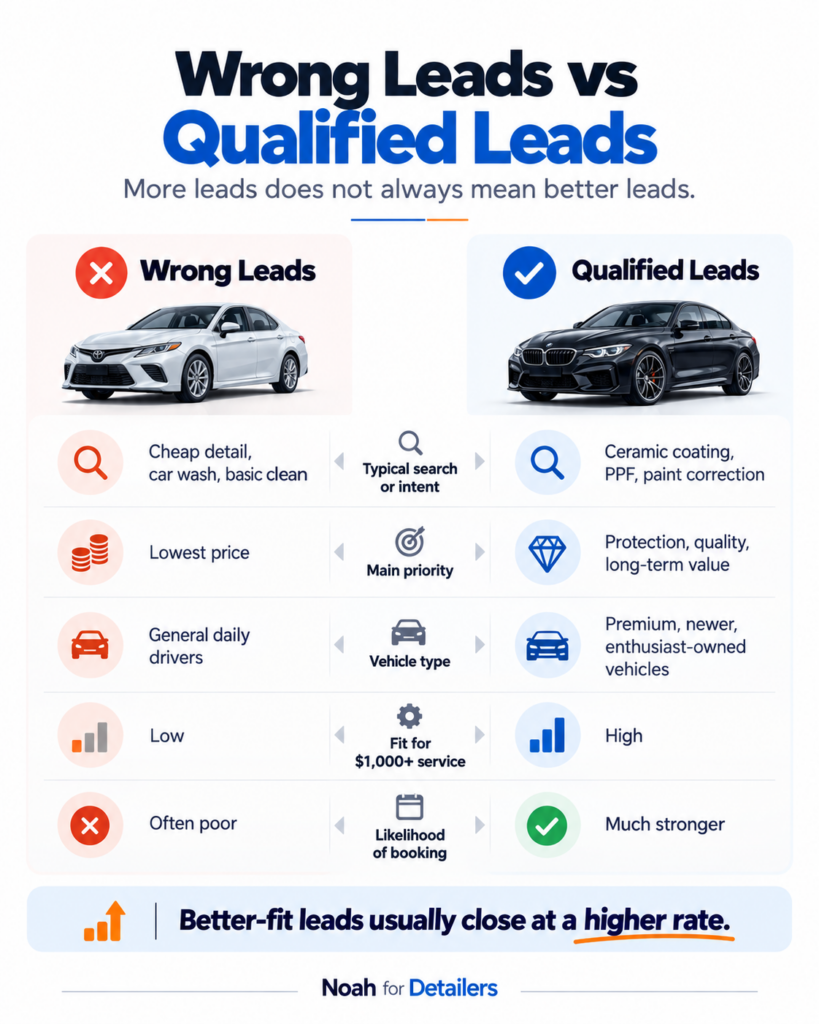
1. You’re Attracting the Wrong Type of Lead
Before reviewing your sales process, ask whether your marketing is attracting customers who want the services you’re trying to sell.
If you offer a $1,500 ceramic coating package but most of your enquiries come from people looking for a $100 detail, even a strong follow-up process will struggle to close that gap.
The mismatch can start with your keywords, offer, or messaging. Searches such as “cheap car detailing,” “car wash near me,” and “interior cleaning” suggest different needs from an enquiry about a ceramic coating package.
Those customers may be perfectly suitable for a business selling maintenance washes or interior cleaning. They may be a poor fit for a campaign focused on paint protection.
Your ad copy can create the same problem. “Make your car look brand new again” leaves plenty of room for interpretation. An ad that names the service, explains its benefits, and speaks to a specific reason for buying gives people a clearer idea of what you offer.
How to fix it
Define your Ideal Client Profile so you know what kind of customer you want your campaign to attract.
Ask:
– What vehicle do they own, and how do they use it?
– What problem are they trying to solve?
– Which service fits that need?
– What would make the service worth the investment to them?
Then align your ads, landing pages, keywords, and offers with those answers. A premium vehicle alone doesn’t make someone a qualified lead; their needs, budget, location, and timing matter too.
Judge lead quality by how well the enquiry fits your service, rather than by how many enquiries you receive.
2. You Take Too Long to Contact the Lead
Someone who requests a quote may also be comparing other detailing shops. If your response arrives several hours later, they may already have discussed their car with another business.
You don’t need to be available around the clock, but you do need a clear process for handling new enquiries. Otherwise, leads can sit unanswered while you’re working on vehicles.
How to fix it
During business hours, aim to respond as soon as you reasonably can. Use an automatic confirmation to acknowledge the enquiry, then follow it with a personal response through the customer’s preferred contact method.
A simple confirmation could say:
Thanks for your ceramic coating enquiry, John. We’ve received your request and will be in touch shortly to learn more about your vehicle and what you’re looking for.
Only promise a response time you can meet. For enquiries received after closing, let the customer know when to expect a reply.
If you call and they don’t answer, send a short message introducing your business and asking when would be convenient to speak.
An automatic reply acknowledges the lead. A personal conversation moves the enquiry forward.
3. You Send a Price Without Explaining the Recommendation
A lead asks, “How much is ceramic coating?” You reply, “$1,200.” The conversation ends there.
You’ve answered the question, but the customer still has little context for the price. They may not understand what’s included, whether the package suits their car, or why your quote differs from another shop’s.
They may also have questions they haven’t asked yet:
– Which package makes sense for my car?
– What preparation is included?
– Does the paint need correction first?
– What results should I expect?
– How do I maintain it afterwards?
How to fix it
Be transparent about pricing while asking enough questions to make a useful recommendation. Avoid making someone go through a lengthy sales conversation just to get a starting price.
For example, if it reflects your actual pricing:
Our ceramic coating packages start at $1,200. The final quote depends on the vehicle and the preparation it needs. What car do you have, and what would you most like to improve or protect?
From there, ask about the paint condition, previous treatments, and the customer’s priorities. Photos or an inspection may help you assess what’s needed before confirming the quote.
Explain how the recommended package addresses those priorities and what the quoted price covers. That gives the customer a clearer basis for deciding whether the service is right for them.
4. Your Offer Is Too Vague
“Premium protection” and “unmatched gloss” sound appealing, but they don’t explain much about the service a customer is buying.
If your offer looks similar to every other option they’re considering, price becomes an easy point of comparison. The customer may not realise that your package includes preparation, aftercare, or other work that a competing quote excludes.
How to fix it
Make the contents of your package easy to understand. Depending on what you actually provide, explain:
– The inspection and preparation process.
– Whether polishing or paint correction is included.
– Which surfaces receive treatment?
– The expected time your shop needs the vehicle.
– The aftercare support available.
– Any warranty coverage, conditions, and maintenance requirements.
A package name can help organise the offer, but the description needs to do the explaining.
For example, New Car Protection Package might include paint decontamination, an enhancement polish where needed, ceramic coating, wheel-face coating, glass protection, and an aftercare consultation.
Only list services you deliver, and make any optional extras clear. The point is to help customers understand the work behind the price.
5. You Haven’t Given the Customer Enough Proof
Someone considering a $1,500 or $2,500 detailing service is making a meaningful purchase and trusting you with their vehicle. A polished description alone may not give them enough confidence to book.
They want to see evidence of your work, understand your process, and hear from previous customers.
How to fix it
Place relevant proof where customers are making decisions. Useful examples include:
– Before-and-after photos that show the results clearly.
– Customer reviews and video testimonials.
– Close-up examples of paint correction work.
– Short videos explaining your preparation and application process.
– Photos of your workshop and team.
– Relevant training or certifications you hold.
Match the proof to the enquiry. If someone asks about paint correction, show a comparable correction job. If they’re considering ceramic coating for a new car, share an example that helps them picture that service on their own vehicle.
You can use this evidence on service pages, quote confirmation pages, and in individual conversations. A short explanation of the vehicle’s starting condition, the work completed, and the result makes a photo more useful.
Make it easy for the customer to see why they can trust your recommendation.
6. You Give Up After One Follow-Up
A customer who doesn’t reply immediately hasn’t necessarily lost interest. They may be busy, comparing packages, discussing the purchase with a partner, or working out when they can leave their vehicle with you.
If you abandon every enquiry after one unanswered message, some interested customers will never receive the help they need to make a decision.
How to fix it
Create a manageable follow-up schedule. Use the following as an example, adjusting it to the customer’s response and preferred timing.
| Timing | Action | Purpose |
| Day 0, during business hours | Respond personally. Call if appropriate, and send a message if there’s no answer. | Start the conversation and understand the enquiry. |
| Day 1 | Ask whether they have any questions or would prefer another time to talk. | Make it easy for them to respond. |
| Day 3 | Share a relevant example, review, or explanation of the recommended package. | Help them assess the service and build trust. |
| Day 7 | Ask whether they’re still considering the work or would prefer to revisit it later. | Clarify their timing and the next step. |
Keep messages useful and personal. For example:
Hi Mark, did you have any questions about the ceramic coating options we discussed? Happy to explain what’s included or help you work out which package suits your car.
Or:
Hi Mark, this is the BMW I mentioned with similar paint condition to yours. I’ve included a few photos and a short explanation of the work we carried out.
If someone gives you a timeframe, follow that instead of continuing a generic sequence. If they decline or ask you to stop, close the enquiry respectfully.
7. You’re Measuring Leads Without Tracking Bookings
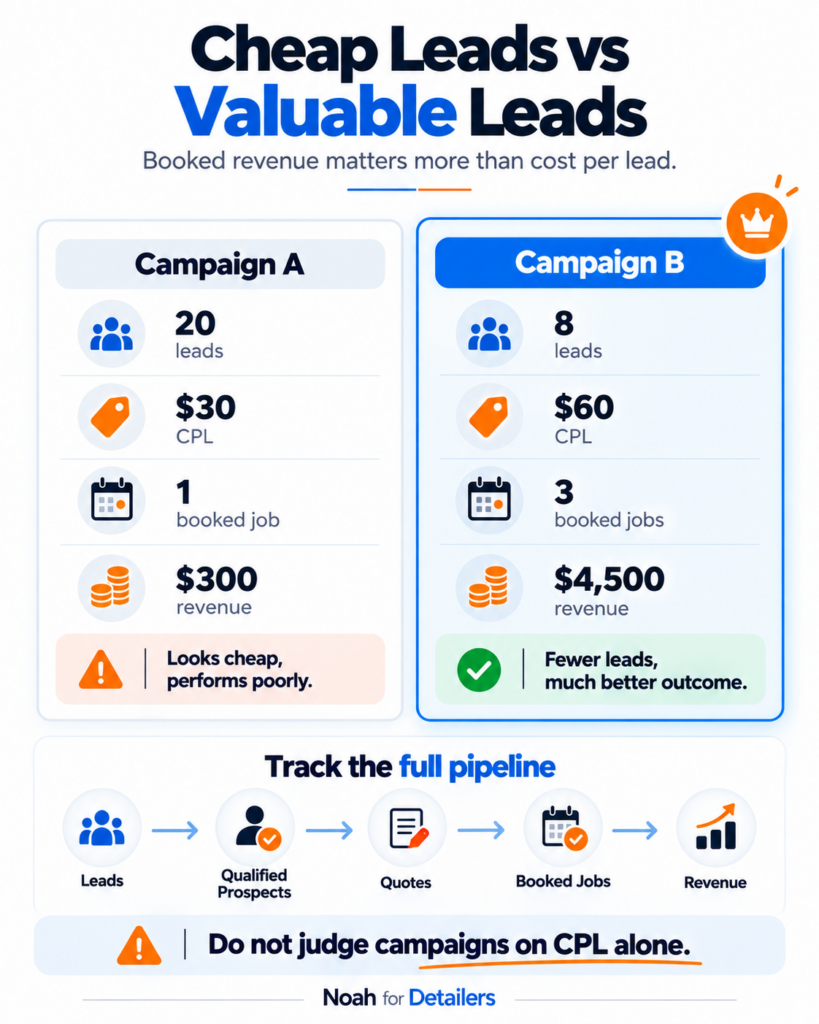
Cost per lead tells you what you paid to generate an enquiry. It doesn’t tell you whether that enquiry became a worthwhile job.
Consider this hypothetical comparison:
| Metric | Campaign A | Campaign B |
| Leads generated | 20 | 8 |
| Cost per lead | $30 | $60 |
| Total ad spend | $600 | $480 |
| Jobs booked | 1 | 3 |
| Average booked job value | $300 | $1,500 |
| Total booked job value | $300 | $4,500 |
| Ad spend per booking | $600 | $160 |
Campaign A produces more enquiries at a lower cost per lead. Campaign B produces more bookings and a higher total booked value, despite its more expensive leads.
These figures are illustrative, and booked value is not the same as collected revenue or profit. You still need to account for cancellations, payment, labor, materials, and other costs.
How to fix it
Track each enquiry through to its outcome. A spreadsheet or CRM should help you record:
- Where the lead came from.
- How well the enquiry fits your services and service area.
- Contact status: reached or awaiting a response.
- Quote status: sent or pending.
- Booking outcome: confirmed, undecided, or declined.
- The booked job value and payment status.
- Why they didn’t proceed, when known.
This helps you identify where to investigate. A high number of unsuitable enquiries suggests a targeting or messaging issue. Qualified leads who stop responding after a quote may need a clearer explanation of the offer, stronger proof, or better follow-up.
If customers accept a quote but don’t schedule, review the booking step itself. Make the available dates, any deposit requirements, and the action needed to confirm the job clear.
Convert More of the Enquiries You Already Receive
More leads can help a detailing business grow, but they won’t resolve a process that consistently loses interested customers.
Before increasing your advertising budget, review how you handle the enquiries already coming in. Are they a good fit? Are you responding promptly? Does your quote explain the value? Have you provided relevant proof and a clear next step?
You don’t need to overhaul everything at once. Identify where people are dropping out, improve that stage, and track whether more of those enquiries turn into completed, paid jobs.
Want More Ceramic Coating, PPF, or Paint Correction Jobs?
At Noah for Detailers, we help detailing businesses build systems for generating qualified enquiries for ceramic coating, paint correction, and PPF through ads, landing pages, and tracking.
If your leads aren’t turning into enough booked jobs, start by understanding where the process is breaking down.
Request a free marketing audit from Noah for Detailers to identify gaps in your ads, landing pages, and enquiry journey.